Roof Insurance Claim Help
We document storm damage, meet your adjuster on the roof and write a line-item scope, while you keep control of your own claim.
How we handle itRoof & Home Tips
A 2% wind and hail deductible can mean thousands out of pocket on a roof claim. Here is how flat and percentage deductibles work and how to find yours before the next storm.
By Lonnie Gatlin, Roof & Home Tips EditorUpdated October 16, 20267 min read
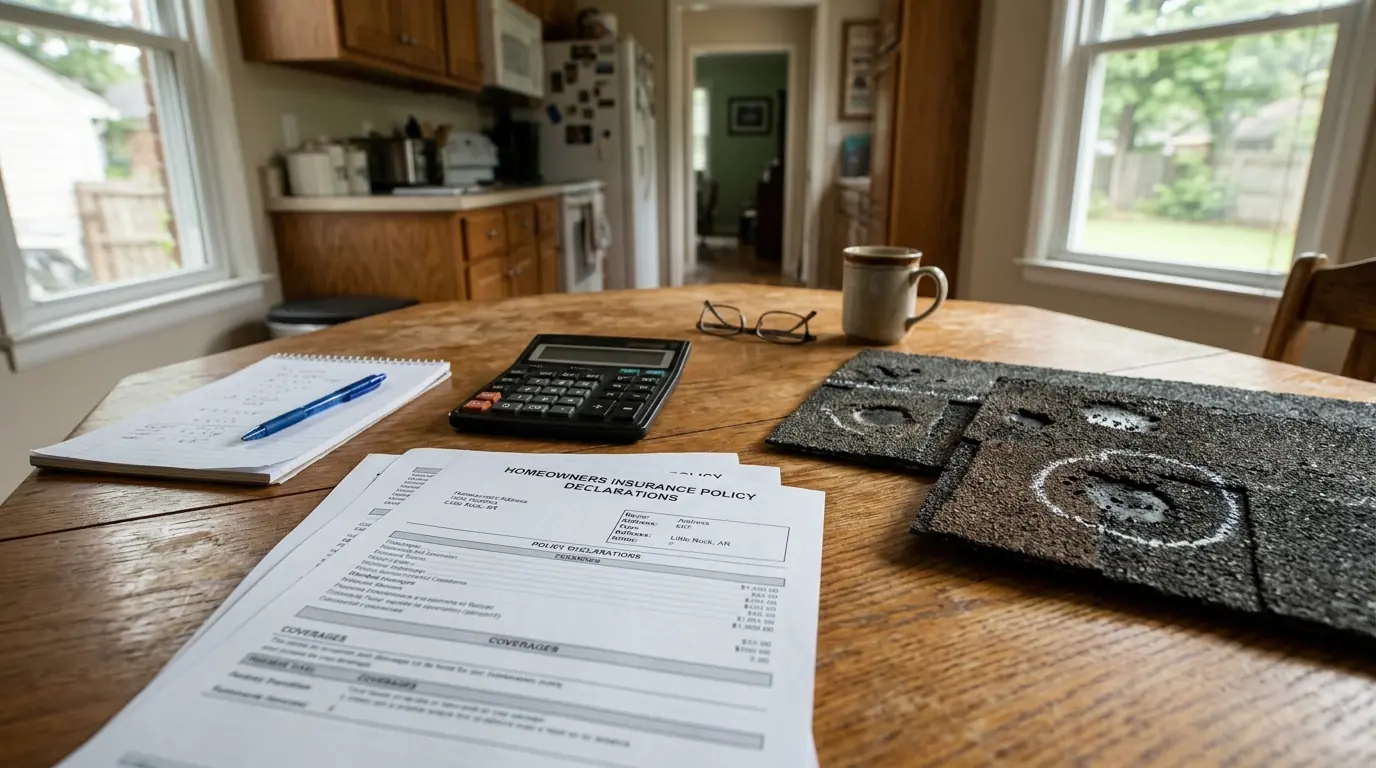
Most homeowners learn what their roof deductible really is on the worst possible day: right after hail or wind has torn up the shingles. In Arkansas, that number is often not the round figure people remember from signing the policy. This guide explains flat and percentage deductibles, where to find yours, and how the math plays out on a typical Little Rock roof claim. It is general guidance, so confirm every detail with your own policy and agent.
Many Arkansas homeowner policies now carry more than one deductible. There is usually an all other perils deductible, which applies to things like a kitchen fire or a burst pipe. Then there may be a separate deductible that applies only to wind and hail damage.
Arkansas was slow to allow this. According to the Arkansas Senate, the state was the last in the country to permit split deductibles, and insurers can now offer a separate deductible for wind and hail. For roof owners, that change matters more than almost anything else in the policy.
Since spring hail and straight-line winds cause most roof claims in central Arkansas, the wind and hail deductible is the one you will most likely pay. Knowing it ahead of time lets you plan instead of reacting.
A few policies go further and carry a separate named storm or tornado provision, while others fold tornado damage into the wind and hail deductible. The labels differ from company to company, so look for the exact words your insurer uses rather than the ones a neighbor mentioned.
A flat deductible is a set dollar figure, such as $1,000 or $2,500. It stays the same no matter how much the house is worth or how large the claim is.
A percentage deductible is figured as a percent of a value on your policy, most often the dwelling coverage limit (often called Coverage A). It is not a percent of the claim. A 1% or 2% deductible sounds small, but on a home with a few hundred thousand dollars of dwelling coverage it can be larger than a typical flat deductible.
Percentage deductibles also rise over time. When your dwelling limit goes up at renewal to keep pace with building costs, the dollar amount of the deductible climbs with it, even if you never changed a thing.
Some policies use the dwelling limit, while a few may use a different value. The wording on your own policy controls, so read how the percentage is calculated rather than assuming.
Percentage deductibles are often paired with a lower premium, which is why they show up on so many renewals. That trade is not always explained well at the time, and many owners only notice the switch when they open a renewal packet and see a percent sign where a dollar figure used to be.
The declarations page, usually the first page or two of the policy, is the summary sheet. It lists your coverages, limits, premium and deductibles. Arkansas lawmakers have pushed for this page to be clearer: Act 471 of 2023 requires insurers to tell customers the dollar amount of a percentage-based deductible, and Senate Bill 48 of 2025 calls for all applicable deductibles on owner-occupied homes to be clearly shown on the declarations page or renewal notice.
Rules can change, and how each insurer formats the page varies. Still, these are the lines worth finding and writing down before storm season starts in March.
Picture a brick ranch in west Little Rock with $285,000 in dwelling coverage. A May hailstorm damages the shingles, vents and gutters, and the insurer's estimate to replace the roof comes to $17,340.
With a flat $1,500 deductible, the homeowner pays $1,500 and the policy covers the remaining $15,840, assuming the claim is approved and no other limits apply.
With a 1% wind and hail deductible, the deductible is 1% of $285,000, or $2,850. The policy covers $14,490.
With a 2% wind and hail deductible, the deductible is $5,700. The policy covers $11,640, and the homeowner carries about a third of the job.
Now take a smaller claim: wind lifts a dozen shingles and a ridge cap section, and the repair runs $685. Under the 2% deductible, nothing is paid, because the repair costs far less than $5,700. That is why we price small repairs on their own before anyone files.
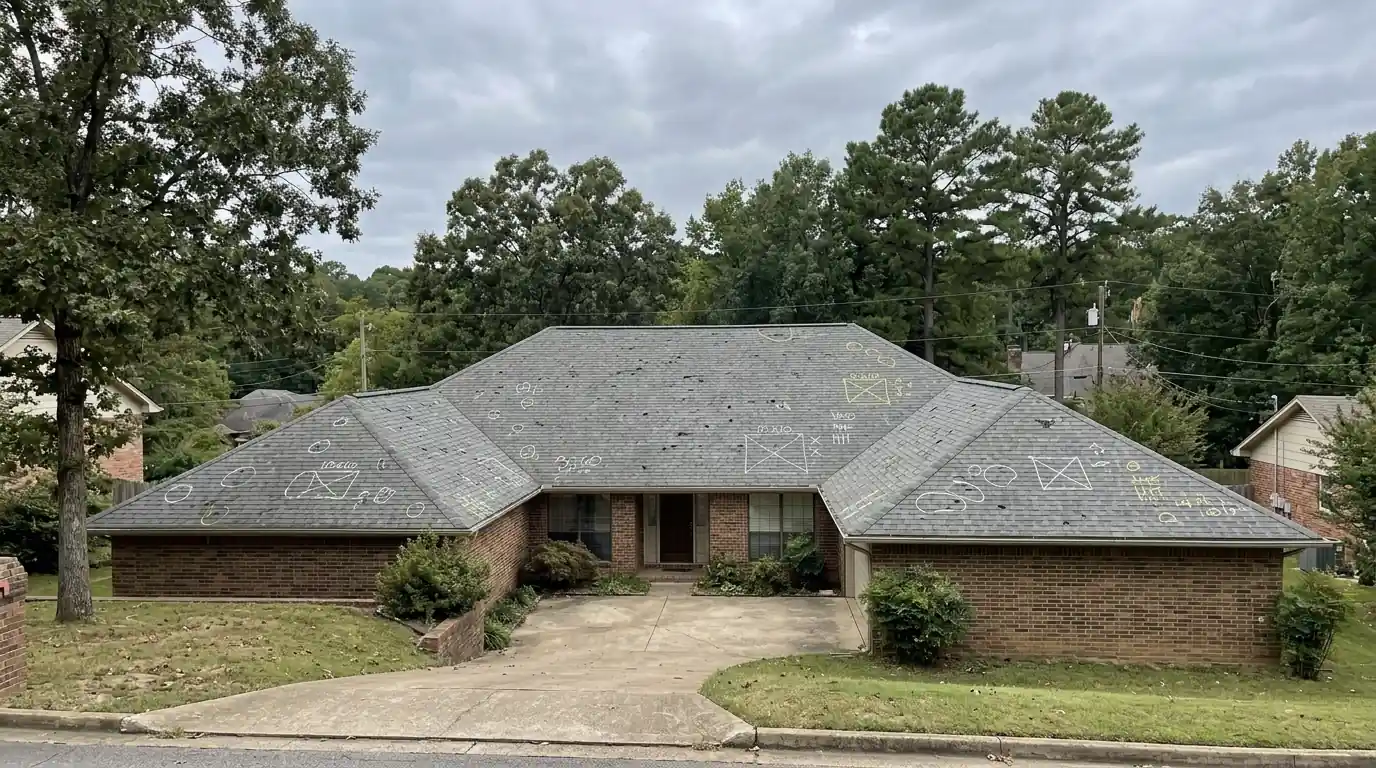
The deductible is only part of the math. If your roof is covered at replacement cost, many insurers first pay the actual cash value, which is the replacement cost less depreciation for the roof's age. The held back portion, often called recoverable depreciation, is released after the work is done and documented.
Using the same $17,340 claim with a 2% deductible: say the adjuster holds back $4,960 in depreciation on a 13 year old roof. The first check would be $17,340, less $4,960, less $5,700, or $6,680. The $4,960 would typically follow once the new roof is installed and the final invoice is sent.
If the roof is covered at actual cash value only, that held back amount may never be paid. Some policies also use a roof payment schedule that pays a shrinking share as the roof ages. Ask your agent which applies to you.
Raising your deductible usually lowers your premium, and that trade can make sense if you have savings set aside. The question to ask yourself is simple: could you pay the full wind and hail deductible next May without borrowing?
Get numbers, not percentages. Ask your agent to quote the premium at two or three deductible levels and to state each deductible in dollars. Then compare the yearly savings to the extra amount you would pay on a claim.
Changes are usually made at renewal or by endorsement, and they apply only to storms after the change takes effect. Calling in February is far better than calling the week after a hailstorm.
Keep a small storm folder too. A copy of the declarations page, the date the current roof went on, and a few clear photos of each slope in good condition make a later claim easier to document and quicker to settle.
Your deductible is your share under the policy. We do not waive, absorb or rebate it, and our invoice matches what you actually pay. Any roofer who offers to cover your deductible is asking you to take a risk with your own claim.
What we do is give you facts. After a storm, we inspect the roof, photograph each damaged area by slope, measure it and tell you plainly whether the damage looks larger than your deductible. If it does not, you get a written price for the repair so you can decide without filing.
If you file, we can meet the adjuster on the roof and give you a line-item scope to compare against their estimate. Coverage decisions belong to your insurer. Call (501) 387-1152 any hour after a storm and we will help you sort out what you are looking at.
Find your dwelling coverage limit on the declarations page, often listed as Coverage A, and multiply it by 0.02. A home with $310,000 in dwelling coverage would have a $6,200 wind and hail deductible. Some policies calculate the percentage from a different value, and insurers are expected to show the dollar figure, so confirm the exact amount with your agent.
Usually the deductible applies once per storm event to the whole covered loss, not separately to each part of the house. Roof, gutters, siding and screens damaged by the same hailstorm are typically added together before the deductible is subtracted. Policies differ, so read the wording on yours and ask your agent how a single storm is handled.
You can usually ask for a change at renewal or by endorsement, and the new deductible applies only to storms after it takes effect. Insurers may limit changes once a storm is forecast or underway. Ask your agent for premium quotes at a few deductible levels, stated in dollars, well before spring storms arrive in March.
We document storm damage, meet your adjuster on the roof and write a line-item scope, while you keep control of your own claim.
How we handle itSlope-by-slope hail inspection with marked test squares, soft-metal checks and photos that show exactly where the stones hit.
How we handle itA complete tear-off to the deck with new underlayment, flashing, vents and shingles, finished in a day or two on most homes.
How we handle it
Permit rules for a new roof in Little Rock are not spelled out in one simple public line. Here is what we confirmed, what we could not, and how to get a clear answer for your address.
October 18, 2026 · 7 min read
Class 4 shingles hold up better to hail, but the discount question is more tangled in Arkansas. Here is what the rating means, what state law covers and what to ask your agent.
October 17, 2026 · 7 min read
Typical 2026 price ranges for a new roof in Little Rock, broken out by material and home size, with the hidden line items that push one quote above another.
October 15, 2026 · 7 min readWant a roofer to look at it?Call any hour. We inspect, photograph and give you a written price.
Call (501) 387-1152