Emergency Roof Tarping
Heavy-duty tarps anchored with wood battens and wrapped over the ridge to keep rain out until permanent repairs are done.
How we handle itRoof repair
A tree on the roof is a framing problem as much as a shingle problem. We work alongside your tree crew, secure the opening, check every rafter in the impact zone and rebuild the roof so it holds.
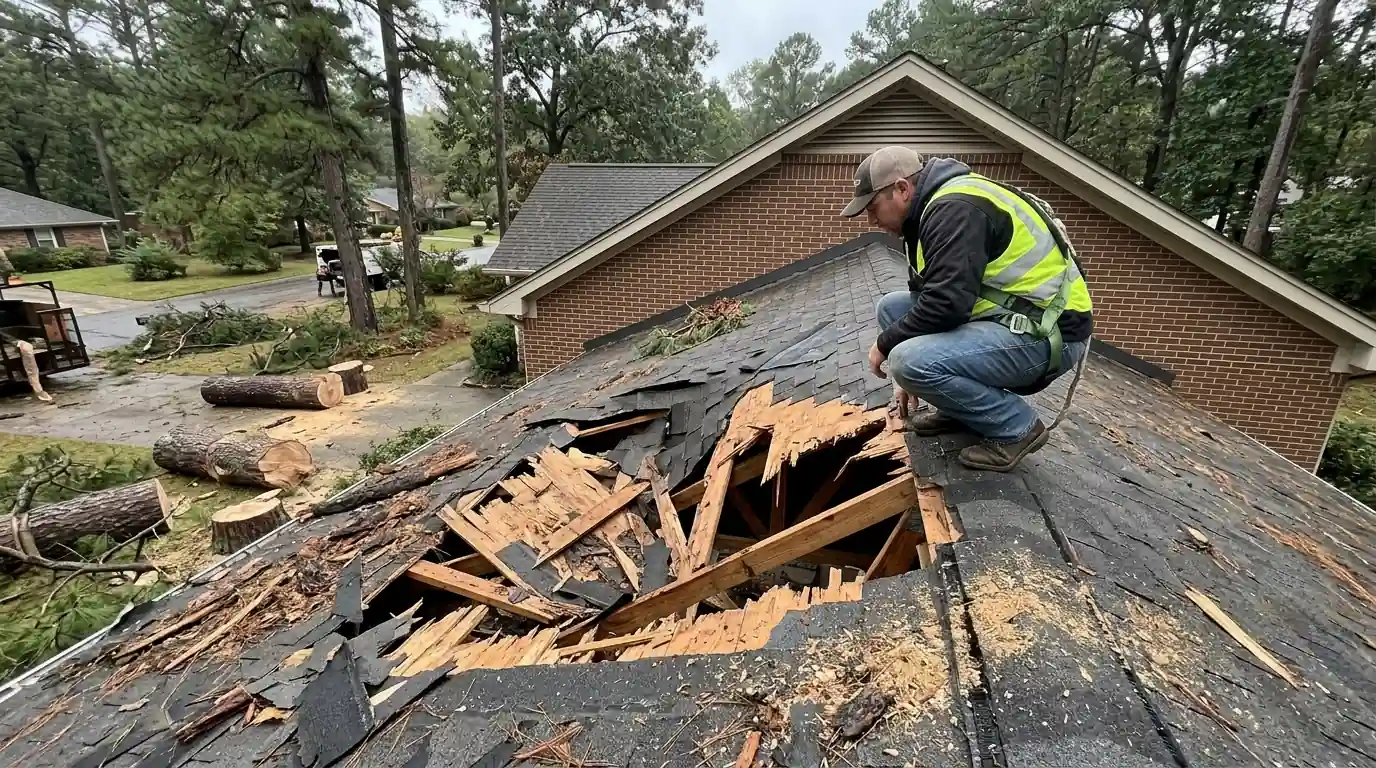
Fallen tree roof damage repair is the structural rebuild after a limb or trunk hits a house: rafters, decking, underlayment and shingles in the impact zone. In Little Rock, typical repairs run $1,380 to $9,600 depending on how much framing broke. A tree service removes the tree itself; we secure the roof the same day it is clear and usually rebuild within a week.
When a tree comes down on a house, the weight is still working on the framing. Keep everyone out of the rooms directly under the impact, including the attic, and do not walk on the ceiling joists to look. A cracked rafter can hold for hours and then let go once rain soaks the load.
If a limb is touching a power line or the service drop, stay well back and call Entergy or your electric co-op first. Turn off power to the affected rooms at the panel if water is reaching light fixtures or outlets.
Then call us at (501) 387-1152. We answer 24/7, talk you through what to watch for and set a time to be on site once the tree is down safely.
We are a roofing company, so we do not cut or crane trees. Removing a trunk from a house takes a tree service with climbing gear, rigging and often a crane or bucket truck. Cutting it wrong can drop the weight harder onto the rafters, so this step belongs to people who do it every day.
Our part is to plan around them. We can talk with the tree crew about where the trunk is bearing, which pieces should come off first and where we need access. Once the last section is lifted off, our crew is ready to cover the opening right away instead of leaving it open to the next shower.
Ask your tree service to leave the area around the impact as clear as they can, and to keep cut sections off the gutters and porch roof on the way down.
If the tree crew cannot come until the next day, ask them for a quick look at whether the trunk is stable where it sits. A tree that is wedged and still is often safer left in place overnight than pulled at by someone without the right gear.
With the weight off, we go inside the attic first. We look for cracked or split rafters, broken truss webs, popped gusset plates, sagging ridge boards and nails pulled out of the top plates. A roof can look fairly flat from the street and still have two or three broken members under the dent.
Decking gets the same attention. Plywood and older plank sheathing can be punctured, crushed or delaminated well past the visible hole, so we cut back to solid wood on all sides. We photograph every broken piece before it is replaced.
If the impact bent a wall, cracked ceiling drywall in a wide pattern or moved a door frame, we tell you plainly and recommend a structural engineer look before the rebuild. That is uncommon, but it does happen when a large trunk falls across a ridge.
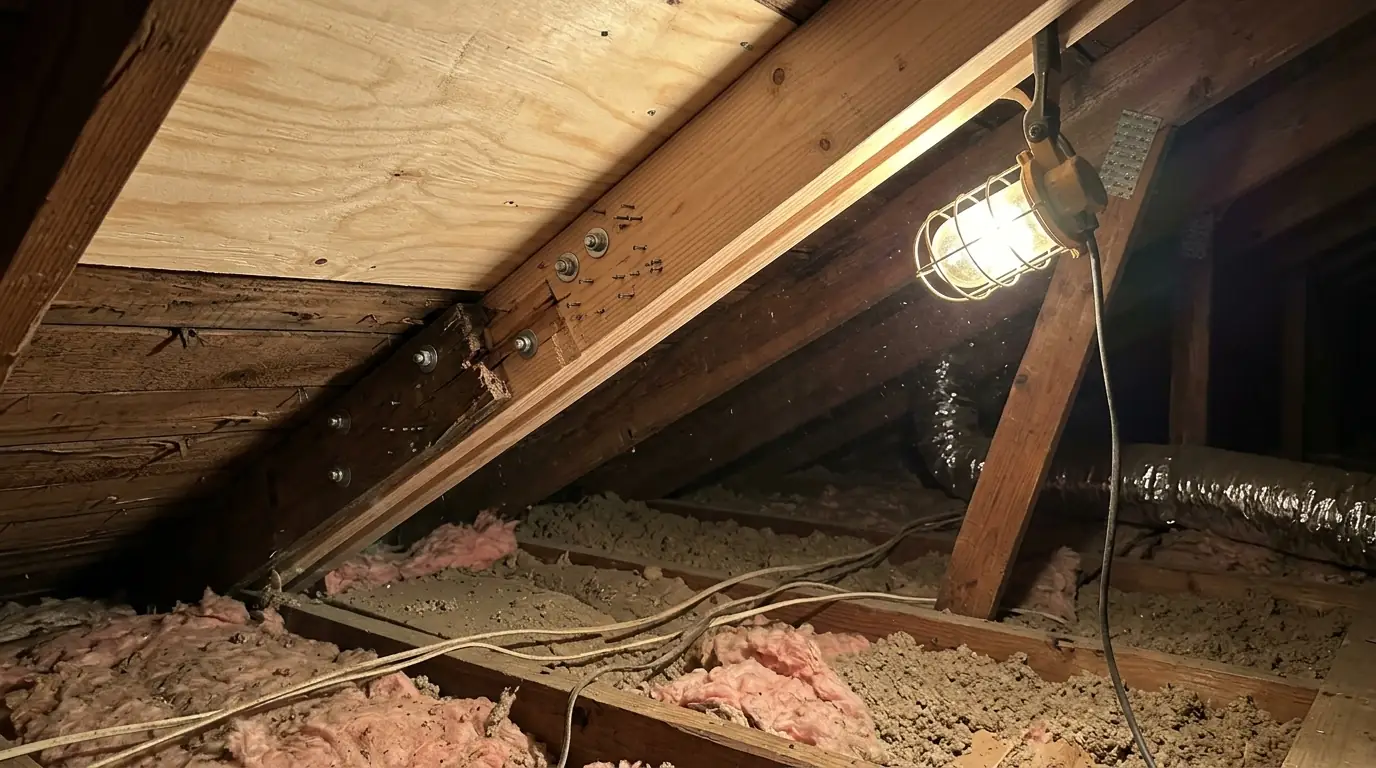
Broken rafters are sistered with new lumber fastened alongside the old, or fully replaced when the damage runs long. Trusses are repaired to the truss maker's guidance or an engineer's letter, not improvised. New decking goes down in full sheets, tied into the surrounding framing.
From there, we install underlayment, drip edge and flashing, then shingles or metal panels matched as closely as possible to the rest of the roof. On older roofs, a perfect color match is not always possible, and we show you samples in daylight so you can decide whether one slope or the whole roof makes more sense.
Gutters, fascia and soffit under a tree hit are often bent or cracked too. We can repair those in the same visit so the house is closed up all at once.
Many established Little Rock neighborhoods have tall loblolly pines and mature oaks close to the house. Pines tend to snap high on the trunk in straight-line winds, while large oaks are more likely to drop heavy limbs or uproot when spring storms soak the ground.
Ice storms are the other big tree season here. A coat of ice adds a lot of weight to branches, and limbs over a roof can break overnight without any wind at all.
After any repair, it is worth having a tree service look at what is still standing. Dead tops, leaning trunks and limbs hanging over the ridge are the ones most likely to come down next.
Pine needles and bark also pack into valleys and gutters during a fall. When we rebuild, we clear that debris from the rest of the roof too, since a clogged valley a few feet away can start its own leak after the next heavy rain.
Most homeowners policies cover damage to the house from a falling tree, though coverage for removing the tree itself is often limited and depends on the policy. Your adjuster will want photos of the tree in place, the broken framing and the rebuild.
We document each step: the tree on the roof, the attic damage, the cut-back decking and the finished repair. You get a written price before any rebuild work starts, which you can share with your adjuster and your tree service.
Tree damage costs depend mostly on how much framing broke under the impact. These are typical 2026 Little Rock ranges for the roofing side only; tree removal is billed by the tree service.
| Job | Typical range | What drives it |
|---|---|---|
| Temporary cover after tree removal | $465 to $1,290 | Size of the opening and roof pitch |
| Decking and shingle rebuild, single impact | $1,380 to $3,740 | Sheets replaced and shingle match |
| Sister or replace broken rafters | $685 to $2,960 | Number of rafters and attic access |
| Truss repair with engineer guidance | $1,240 to $4,870 | Truss count and engineer letter needed |
| Large impact across the ridge, full rebuild | $4,350 to $9,600 | Framing, decking and slope replacement |
The biggest swings come from broken framing, a ridge-line impact and whether a full slope needs new roofing to match. See the full roof pricing guide.
How the job goes
We talk you through keeping clear of the impact rooms and set a site time around the tree service.
As soon as the trunk is lifted off, our crew covers the opening to keep rain out of the framing.
We inspect rafters, trusses and decking from inside and photograph every broken member.
You get a written scope and price covering framing, decking, roofing and any gutter or fascia work.
We repair the framing, install new decking and roofing, then clean up debris and run a magnet sweep for nails.
Usually you can stay, but keep everyone out of the rooms and attic directly under the impact until the weight is off and the framing is checked. If you hear cracking, see the ceiling bowing or smell gas, leave the house and call 911. Otherwise, turn off breakers to wet fixtures and keep clear of the damaged area.
No. Tree removal is done by a tree service with rigging and lifting equipment, and that is the safest way to take weight off a house. We coordinate with them on timing and access, then cover and rebuild the roof once the tree is clear. Many homeowners call both of us the same morning.
We go into the attic and look at every rafter or truss near the impact for splits, cracks, pulled nails and sag. A dent in the shingles is not always a reliable guide, since a heavy trunk can break framing several feet from the visible hole. We photograph each broken member so you and your adjuster can see it.
We match brand, style and color as closely as the market allows. On a roof more than a few years old, new shingles often look slightly different until they weather. We show you samples on site in daylight, and when the difference is obvious from the street, we price replacing the full slope so you can choose.
Most single impact rebuilds take one to two days once materials are on hand. Jobs with several broken rafters or truss repairs can take longer, especially if an engineer letter is needed first. The opening stays covered the whole time, so the house is protected while the rebuild is scheduled.
Related work
Heavy-duty tarps anchored with wood battens and wrapped over the ridge to keep rain out until permanent repairs are done.
How we handle itRotted, soft or delaminated roof sheathing cut out and replaced so new shingles or metal have a solid base to fasten into.
How we handle itFull roof assessment after a severe storm, covering debris impacts, mixed hail and wind damage, gutters and the attic below.
How we handle itWe document storm damage, meet your adjuster on the roof and write a line-item scope, while you keep control of your own claim.
How we handle itTalk to a roofer nowCall and describe what you are seeing. We answer around the clock.
Call (501) 387-1152