Flat Roof Repair
Leaks, ponding water, split seams and failed drains fixed on low slope roofs for homes, porches, offices and small commercial buildings.
How we handle itFlat & commercial
Modified bitumen is the tough, layered sheet roof that keeps low-slope sections dry when shingles cannot. We repair worn mod bit and install new systems across Little Rock and central Arkansas.
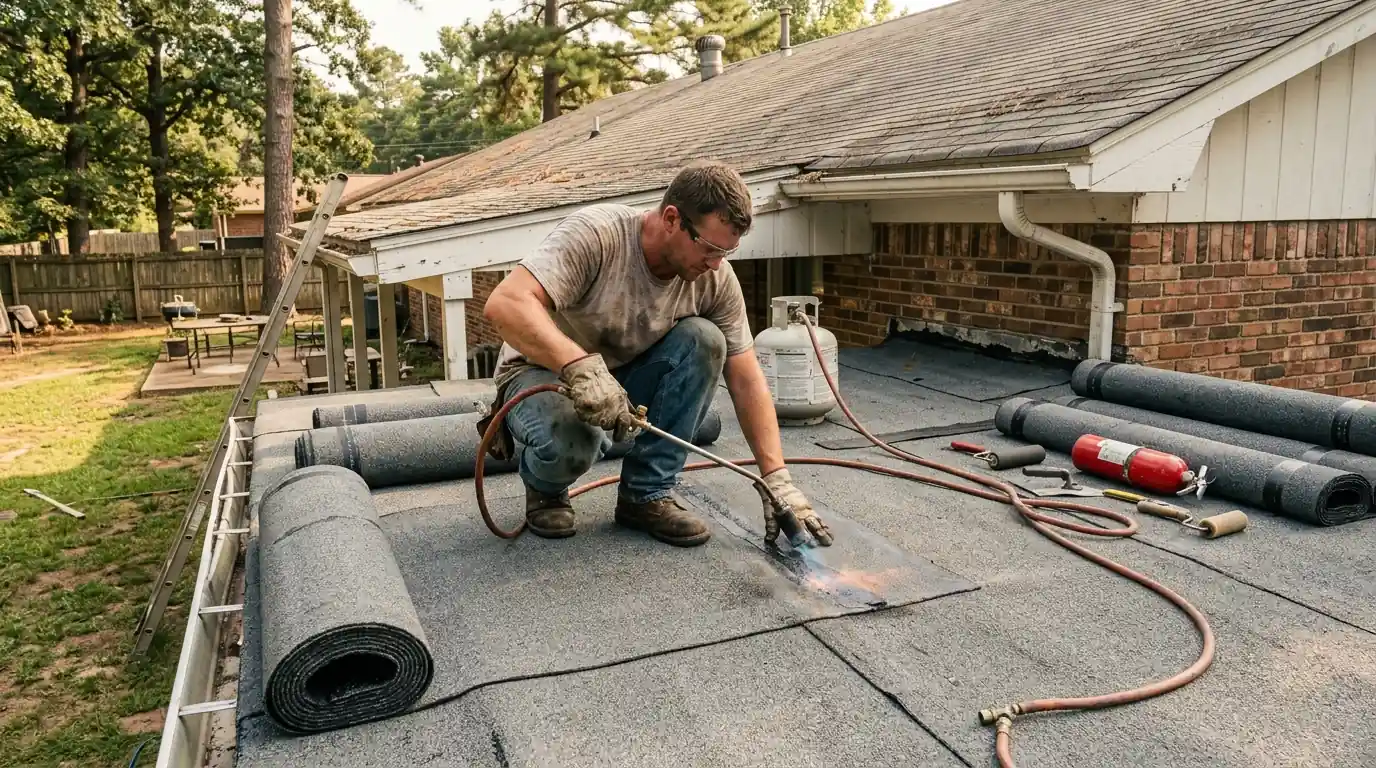
Modified bitumen is an asphalt sheet roof reinforced with polyester or fiberglass and built in layers for slopes too flat for shingles. Typical Little Rock costs run $365 to $1,140 for seam and patch repairs and $7.35 to $11.90 per square foot for a full tear-off and two-ply replacement. Most porch and addition roofs are finished in one to two days.
Modified bitumen, often called mod bit, is asphalt blended with rubber or plastic modifiers and rolled onto a reinforcing mat. The modifiers let the sheet stretch in summer heat and stay flexible on cold January mornings, which plain built-up tar roofs never managed well.
It belongs on roofs with a pitch of roughly half an inch to two inches per foot. Around Little Rock that usually means a rear porch tied into the main roof, a den addition from the 1970s, a carport, a garage apartment or the flat center section of a mid-century ranch.
Shingles on those slopes let water creep backward under the tabs. Mod bit forms a continuous membrane instead, so standing water after a heavy storm sits on top of the roof rather than working its way into the deck.
Building owners use it as well. Small office buildings, church fellowship halls and older strip retail around central Arkansas often carry mod bit because it handles foot traffic from HVAC technicians better than thinner single-ply sheets.
There are two main families. SBS sheets use a rubbery modifier and stay pliable in cold weather, so they can be installed with cold adhesive or self-adhered laps. APP sheets use a plastic modifier and are traditionally torched, which gives very strong laps but brings open flame to the roof.
On homes we lean toward self-adhered and heat-welded SBS systems because they keep open flame away from wood fascia, attic vents and older framing. Commercial jobs with large open areas sometimes call for a different method, and we explain why before any work is priced.
Not every tired mod bit roof needs to come off. Blisters, split laps and bald patches where the granules have washed away can often be cut out and patched with matching material if the deck underneath is still sound.
We probe soft spots, check whether the insulation below is wet, and photograph what we find so you can see the condition for yourself. If more than about a quarter of the field is blistered or the base sheet is saturated, a patch only buys a season, and we will say so plainly.
Common repair work includes resealing laps at the outside edge, rebuilding the flashing where the low roof meets a brick wall, and replacing the strip along the gutter edge where water pools longest.
Little Rock summers are the hardest test. A dark cap sheet on a west-facing porch can run far hotter than the air temperature on a July afternoon, and years of that heat slowly dry out the asphalt until laps open and the surface crazes like old pavement.
Spring brings the second problem. Hail from March through June knocks granules loose and bruises the sheet, then the heavy rain bursts that follow test every weak lap at once. Low roofs under tall oaks and pines also collect leaves and needles that hold moisture against the surface and block drains.
Winter freeze and thaw is milder here than up north, but an ice storm can still leave water trapped behind debris long enough to find a pinhole. A clean roof with clear scuppers sheds all of this far better than one buried in leaves.
Pine needles are a particular nuisance on mod bit. They mat together in the corners, wick moisture against the cap sheet and feed moss on shaded north sides, so a simple cleanout each fall does more for the roof than most people expect.
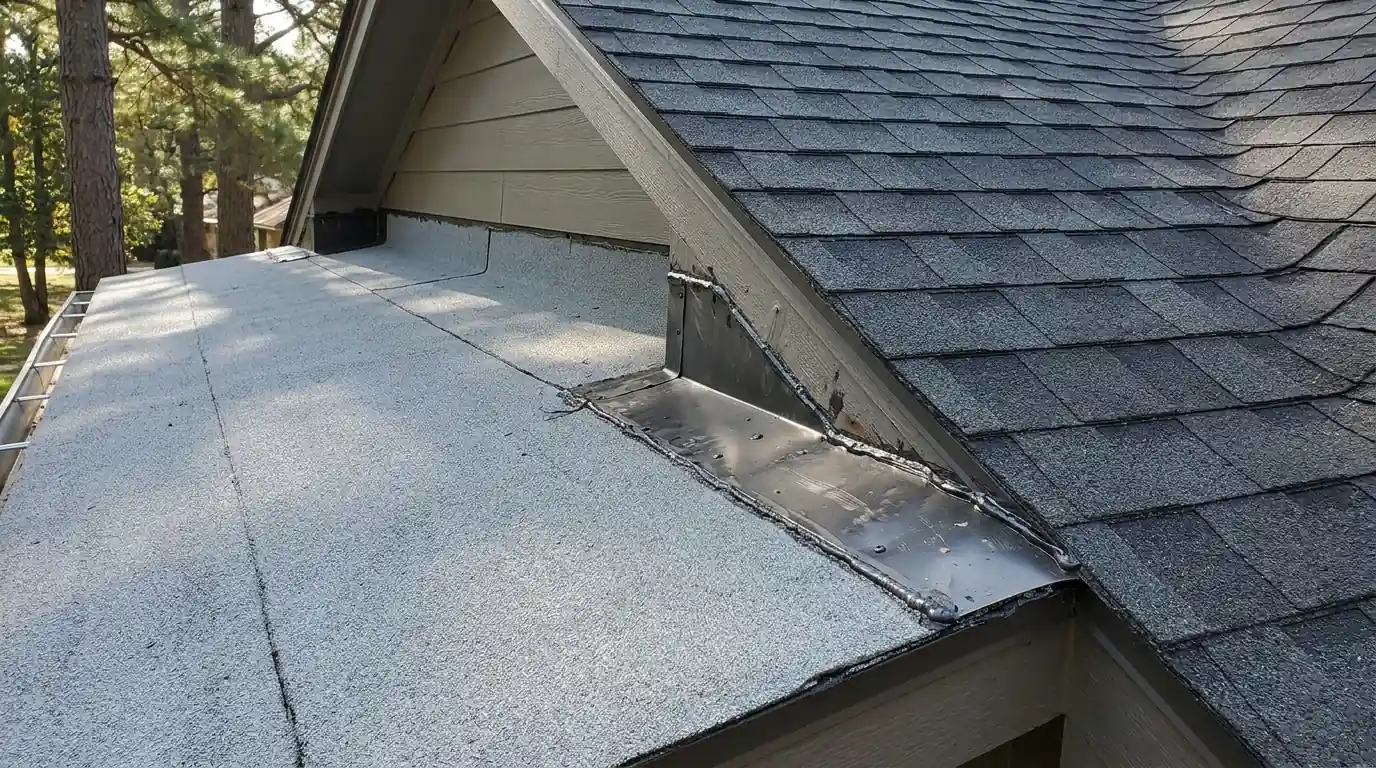
Most leaks on low roofs show up at transitions, not in the middle of the sheet. The joint where a porch roof meets the shingled main roof, the wall flashing against siding or brick, and the drip edge over the gutter all need careful detailing.
We weave the mod bit up under the shingles at the tie-in, install new counterflashing where the old metal has rusted, and set edge metal so water drops cleanly into the gutter instead of curling back toward the fascia. Skylights, vent stacks and HVAC curbs on the low section get their own flashed collars.
Mod bit is a strong fit for small and medium residential low slopes, but it is not the only choice. A large commercial roof with lots of open field may be better served by TPO, and a sound mod bit roof that is simply aging may be a candidate for a coating instead of a tear-off.
We walk the roof, look at drainage, foot traffic and how long you plan to own the building, and then give you a written price for the option that fits. If replacement is not needed yet, we tell you that too.
Cost of ownership is part of that talk. Mod bit sits between a coating and a full single-ply tear-off in price on most small roofs, and its thicker, layered build tends to shrug off the occasional dropped tool or limb better than thin sheets.
These are typical 2026 ranges we see on modified bitumen work around Little Rock. Your written price comes after we see the roof.
| Job | Typical range | What drives it |
|---|---|---|
| Seam, blister or patch repair | $365 to $1,140 | Number of problem spots and whether the base sheet is wet |
| Wall flashing and edge metal rework | $640 to $2,180 | Linear feet of wall and whether brick needs a reglet cut |
| Porch or carport replacement up to 400 sq ft | $2,860 to $5,940 | Layers to remove, deck repairs and tie-in to shingles |
| Full tear-off and two-ply system per sq ft | $7.35 to $11.90 | Insulation board, drains, roof access and total size |
Wet insulation, rotten decking and the number of old layers to remove are the biggest swings in price. See the full roof pricing guide.
How the job goes
We check laps, blisters, drains and the deck below for soft or wet areas. Photos of every problem spot come back to you.
You get a written price for patching or for a full two-ply system, with the reasons for each laid out clearly.
Old layers come off down to the boards, rotten decking is replaced, and edge metal and drains are set before membrane goes down.
The base sheet goes down first, then the granulated cap with offset laps heat-welded or self-adhered tight.
Wall flashing and tie-ins are finished, debris is hauled off, and we run a magnet sweep for nails around the house.
A well installed two-ply mod bit roof commonly lasts around 15 to 20 years in central Arkansas, sometimes longer on a shaded porch with good drainage. Hot west exposure, ponding water and debris left sitting on the surface shorten that. Keeping scuppers and gutters clear and checking the laps after hail season are the simplest ways to get the full life out of it.
Yes. On most homes we use self-adhered or heat-welded SBS sheets so there is no open flame near wood fascia, attic vents or older framing. Torch-applied APP sheets still have a place on some commercial roofs, but for a porch or addition attached to a house, a flameless method is usually the safer and equally durable choice.
For small residential sections like porches, carports and additions, mod bit is often the better fit because it handles foot traffic, tolerates small details well and ties neatly into shingles. TPO shines on larger open roofs where its wide sheets and welded seams save labor. We look at the size, the details and your budget before recommending either one.
Ponding usually means the deck has sagged, the slope was built too flat, or the drain edge sits higher than the field. Debris at the scupper can also hold water back. A little water that dries within two days is common, but longer ponding ages the sheet faster, so we may add tapered insulation or rework the edge during replacement.
Sometimes, if there is only one existing layer, it is dry and the deck is solid. Covering a wet or blistered roof traps moisture and the new sheet blisters too. We cut a small test area to check before deciding. In most Little Rock homes with older built-up tar or multiple layers, a full tear-off gives the more reliable result.
Related work
Leaks, ponding water, split seams and failed drains fixed on low slope roofs for homes, porches, offices and small commercial buildings.
How we handle itWhite single ply TPO membrane with hot air welded seams for low slope homes, additions and commercial roofs facing hot Arkansas summers.
How we handle itSilicone and acrylic coatings that restore sound flat and metal roofs, applied by our crews after proper cleaning and repairs.
How we handle itNew covered patios, porch roof rebuilds and leak repairs, framed and tied into the main roof so water runs away from the house.
How we handle itTalk to a roofer nowCall and describe what you are seeing. We answer around the clock.
Call (501) 387-1152