Metal Roofing
Ribbed exposed-fastener metal panels for homes, porches, barns and shops, a durable and budget-friendly choice for central Arkansas.
How we handle itNew roofs & materials
Outbuildings get worked hard, and their roofs take the abuse. We re-panel, re-screw and rebuild metal roofs on shops, barns, carports and detached garages across rural central Arkansas, starting with the purlins underneath.
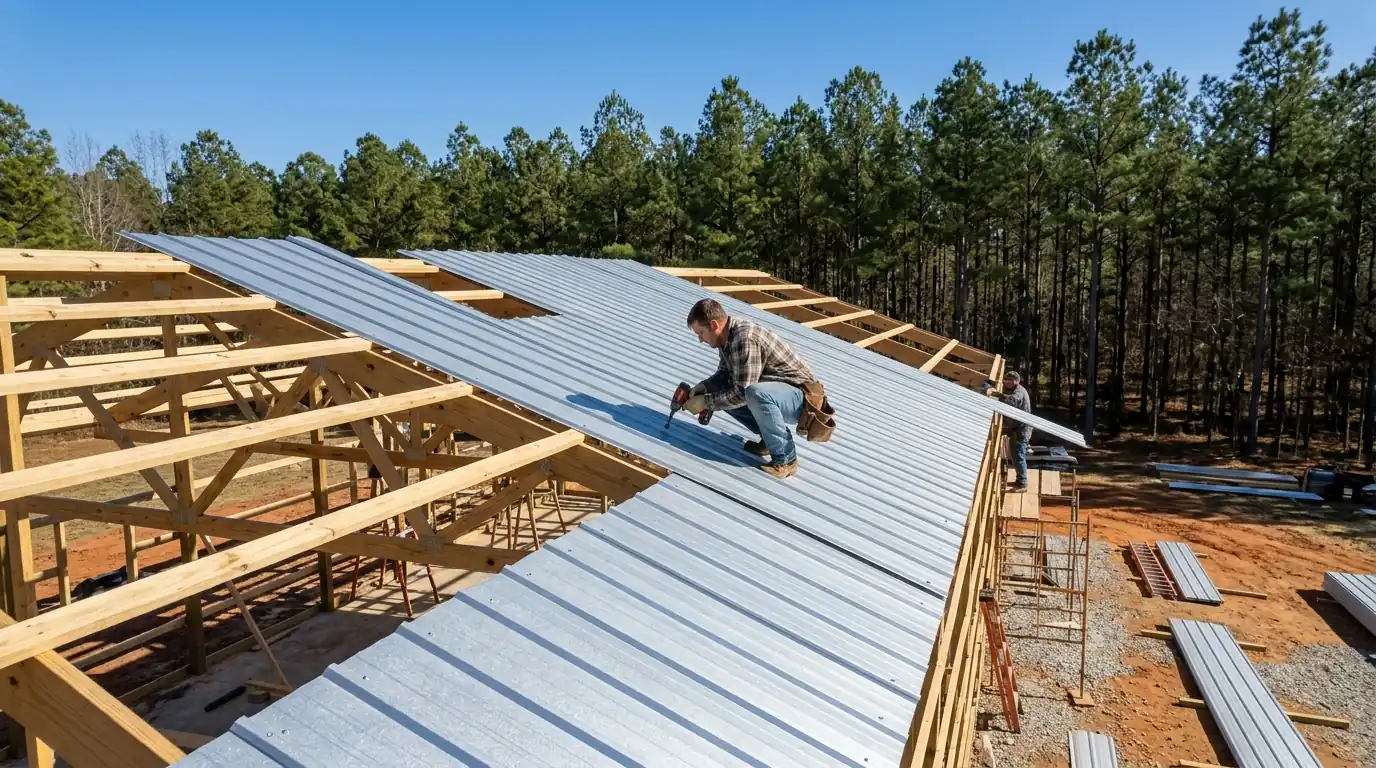
Barn and shop metal roofing is new or replacement exposed-fastener panels on post-frame and open-framed outbuildings, fastened to wood or steel purlins instead of a solid deck. Around Little Rock, re-roofing a 30 by 40 shop typically runs $5,640 to $10,880. Most shop and carport roofs take one to three days, and larger barns take a few more.
Most barns and shops in central Arkansas are post-frame buildings. Instead of plywood decking, the panels screw straight into horizontal purlins, usually 2 by 4 lumber laid flat or on edge, spaced roughly two feet apart and carried by trusses or rafters set on the posts.
That changes everything about the job. Screws have to land in the purlins, not in open air, and the panels themselves carry the snow, wind and foot load between supports. A sagging or rotted purlin shows up as a wave in the roof and a ring of loose screws around it.
Detached garages are a mix. Some have sheathing and can take a house-style roof, while others are open-framed like a shop. We check which you have before quoting.
Pitch matters as well. Many older barns run low slopes, and low-slope metal needs tighter lap sealing and careful trim at the ridge to keep wind-driven rain from creeping uphill under the panels.
Before any new metal goes up, we walk the framing from below. We look for purlins that have rotted at the eave where water drips, split from old screws, or bowed under years of load. On older barns, we often find mixed spacing where a past repair added or skipped a row.
Damaged purlins are replaced or doubled, and missing blocking is added at the eaves and ridge so trim has something solid to fasten to. Where purlin spacing is too wide for the panel gauge you want, we add rows rather than hoping the panel spans it.
Truss problems such as cracked chords or rusted steel connections get photographed and priced separately, so you know exactly what you are paying for.
Plenty of outbuilding roofs have good panels and worn fasteners. On older barns, nails or early screws with thin washers loosen as the building flexes, and the holes slowly widen until every rain drips through the same rows.
A full re-screw replaces each fastener with an oversized screw and a fresh washer, set snug enough to seal without crushing. We also check the side laps, where most shop leaks start, and add lap screws or butyl tape where the seams have opened.
Re-screwing makes sense when the panels are mostly rust-free and the purlins are sound. When panels are thin, holed or rusted through at the laps, new metal costs less over time than patching.
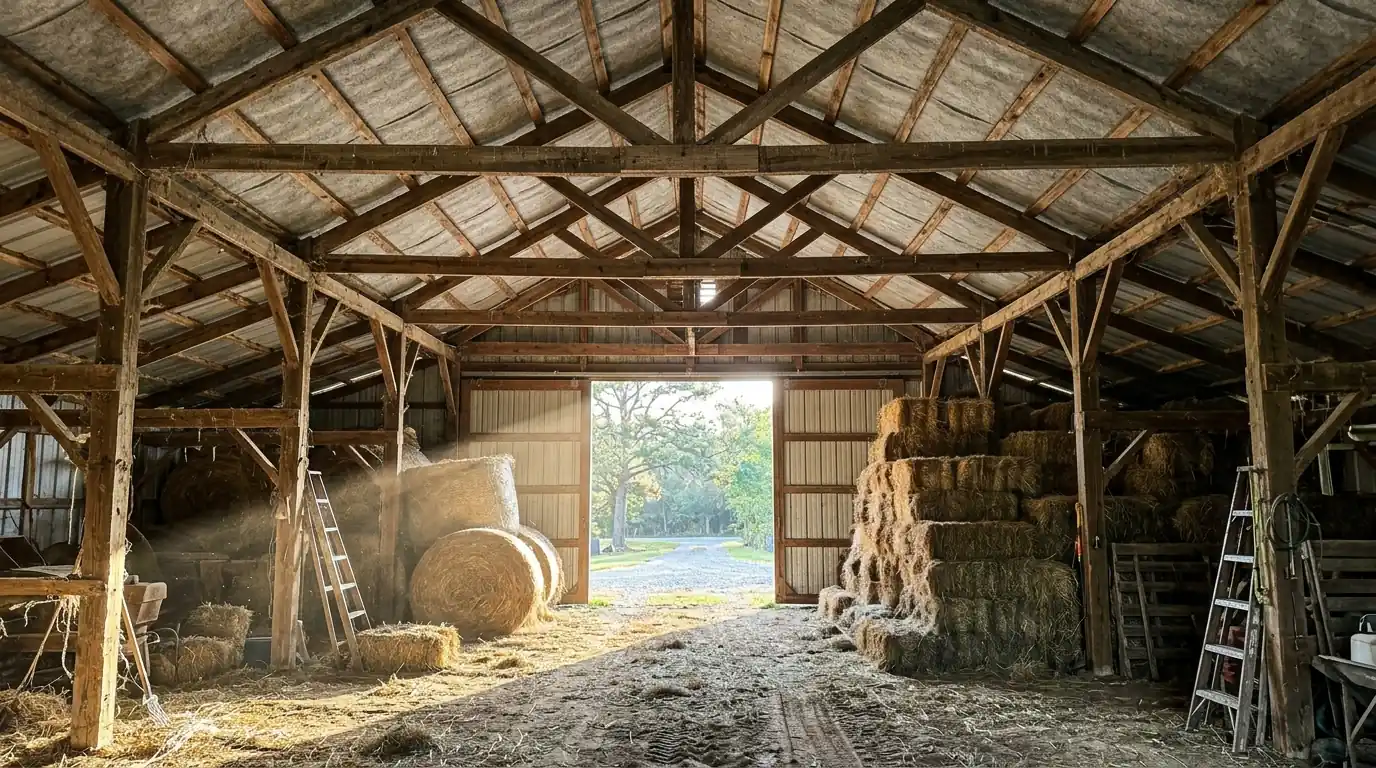
A dripping ceiling on a clear morning is almost always condensation, not a leak. Warm, humid air inside the building meets the cold underside of the panel overnight, and water forms and falls. In central Arkansas, with its humid springs and falls, this is one of the most common complaints we hear about outbuildings.
The fix depends on how the building is used. For hay barns and open equipment sheds, a factory-applied drip-stop fabric on the underside of new panels catches moisture and lets it evaporate. For enclosed shops that may be heated or insulated, a faced insulation blanket or a vapor barrier installed over the purlins works better.
Ventilation matters too. A vented ridge or gable vents in a closed shop help clear the moist air that causes the problem in the first place.
Rust on outbuildings tends to start in predictable places: the lower few feet of panels where they sit near the ground, along eaves where water runs off, around old screw holes and anywhere stored fertilizer, hay or livestock create damp, corrosive air.
On livestock barns, we lean toward galvalume or a heavier painted panel and keep panel edges up off the ground on wall sections. Under pine and oak cover, needles and leaves trap moisture at the eave, so trimming back overhanging limbs helps the new metal last.
Translucent skylight panels are another wear point. Older ones turn brittle and yellow, and we can swap them for new clear panels in matching profile when we re-roof.
Gravel drives and long farm roads are part of the job too. We plan material drops so delivery trucks can reach the building without rutting a wet pasture, and we stage panels on blocks off the ground until they go up.
Our crews re-roof and build new metal roofs on workshops, horse and cattle barns, hay sheds, lean-tos, carports, RV covers and detached garages around Little Rock and the surrounding counties. Saline, Lonoke, Faulkner, Grant and White County properties make up a good share of this work.
Every job starts with a site visit and a written price before work begins. Manufacturer terms on paint and panels depend on the product and registration, and we explain what applies to your building. Call (501) 387-1152 to set a time to look at your outbuilding.
Outbuilding roofs are priced by size, panel gauge, framing repairs and the moisture control you choose. These are typical 2026 central Arkansas ranges.
| Job | Typical range | What drives it |
|---|---|---|
| Re-roof a 30 by 40 post-frame shop | $5,640 to $10,880 | Gauge, tear-off and purlin repairs |
| Re-roof a 40 by 60 barn | $9,850 to $18,370 | Roof pitch, access and panel choice |
| Full re-screw of a shop or barn roof | $1,180 to $3,460 | Building size and lap sealing needed |
| Carport or lean-to re-panel | $1,460 to $4,290 | Size, open sides and trim |
| Purlin replacement, per run | $145 to $430 | Length, height and access from below |
Rotted framing, livestock or equipment that must be worked around, and steep access roads add labor and time. See the full roof pricing guide.
How the job goes
We check purlins, trusses and spacing from inside the building and photograph any damage.
We match gauge, profile and condensation control to how the building is used, then give you a written price.
Rotted or split purlins are replaced and blocking is added where trim needs a solid fastening point.
New panels go on square with screws set into the purlins, then ridge, rake and eave trim are installed.
We pick up scrap metal and screws and run a magnet sweep, especially where tires and hooves travel.
That is almost always condensation. Humid air inside the shop hits the cold underside of the metal overnight and turns to water. A re-roof with drip-stop backed panels, faced insulation over the purlins or better ridge venting usually solves it. We look at how the shop is used before recommending one, since a heated shop needs a different fix than a hay barn.
Sometimes. If the old panels are flat enough and the framing is sound, new purlins can be laid over the existing roof and new panels screwed to them. It saves tear-off cost, but it also hides rot and adds weight. We check the trusses first and tell you honestly whether a tear-off is the better choice.
Many post-frame buildings use purlins about 24 inches apart, but the right spacing depends on panel gauge, roof pitch and the panel maker's span tables. Thinner 29 gauge panels need closer support than heavier 26 gauge. When an old barn has uneven or wide spacing, we add purlin rows before the new metal goes on.
It often is, if the panels are mostly sound and the purlins are solid. A full re-screw with oversized fasteners and new washers, plus sealing the side laps, fixes most outbuilding leaks. If the panels have rust holes, thin spots or failed laps across the roof, new panels are usually the better use of your money.
Yes. We re-roof carports, lean-tos, RV covers and detached garages along with shops and barns. Open carports usually need heavier trim and careful fastening at the edges since wind can get under them. Garages with sheathed roofs can take shingles or metal, and we help you pick based on the house and your budget.
Related work
Ribbed exposed-fastener metal panels for homes, porches, barns and shops, a durable and budget-friendly choice for central Arkansas.
How we handle itFixing leaks on existing metal roofs: backed-out screws, cracked washers, loose seams, rust spots and failed flashing or trim.
How we handle itNew covered patios, porch roof rebuilds and leak repairs, framed and tied into the main roof so water runs away from the house.
How we handle itBalanced ridge and soffit ventilation that lets hot, damp attic air out and helps shingles, decking and AC systems last longer.
How we handle itTalk to a roofer nowCall and describe what you are seeing. We answer around the clock.
Call (501) 387-1152