Flat Roof Repair
Leaks, ponding water, split seams and failed drains fixed on low slope roofs for homes, porches, offices and small commercial buildings.
How we handle itFlat & commercial
TPO is a white, single ply membrane whose seams are welded with hot air into one continuous sheet. On central Arkansas low slope roofs, it reflects summer heat and handles ponding better than most older flat roof systems.
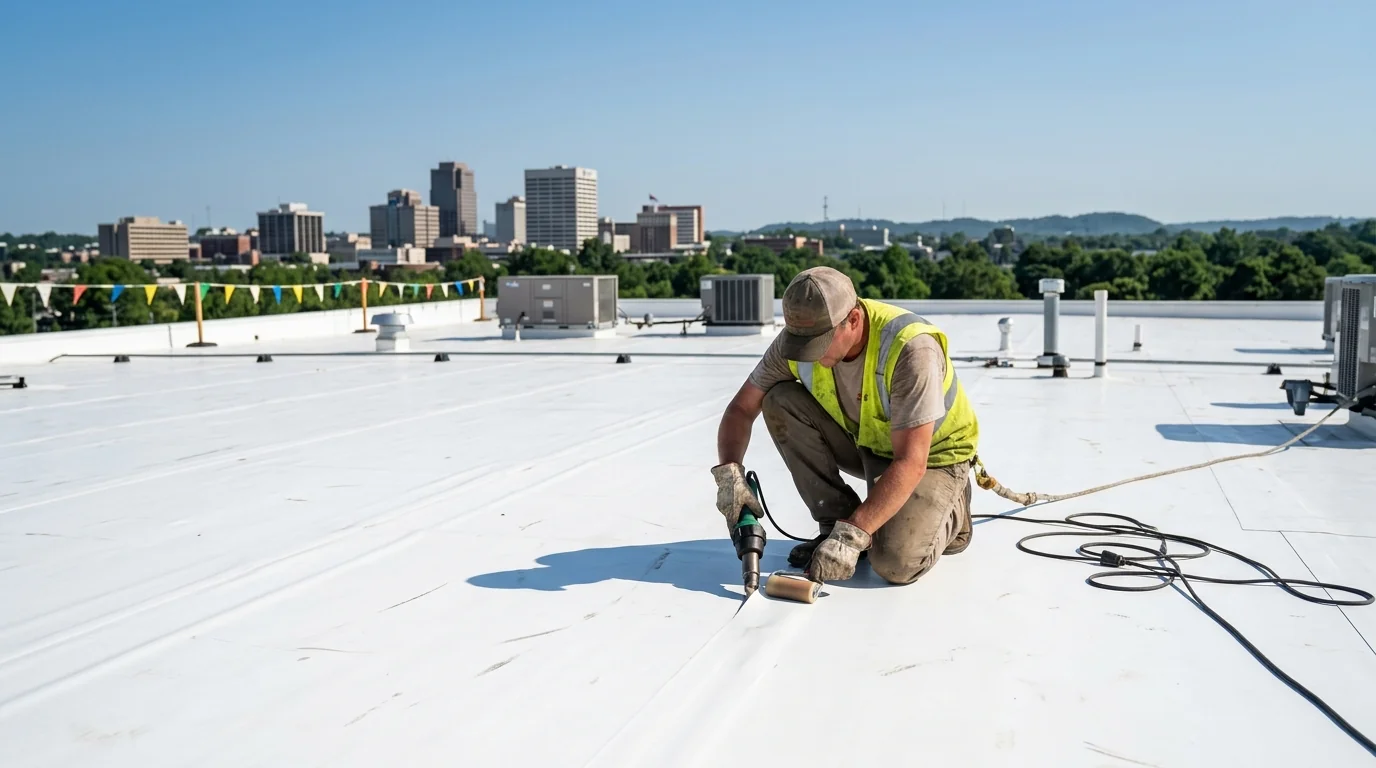
TPO roofing is a thermoplastic single ply membrane, usually white, installed over insulation board with heat welded seams. In Little Rock, a new TPO roof typically costs $7.40 to $11.80 per square foot installed, depending on insulation, tear-off and roof details. Small residential flat sections often take one to two days, and larger commercial roofs take several days to a few weeks.
TPO stands for thermoplastic polyolefin. It comes in wide rolls of reinforced membrane, most often white, sometimes gray or tan. Because it is thermoplastic, the seams can be melted together with a hot air welder, so adjoining sheets become one piece instead of being glued.
It is used on low slope roofs from about a quarter inch per foot up to slopes where shingles are not allowed. On homes, that means flat additions, porch roofs, carports and the low sections behind dormers. On commercial buildings, it covers offices, warehouses, churches, retail strips and apartment buildings across central Arkansas.
TPO is lighter than gravel built-up roofs and many coating systems, which can matter on older buildings. It is also one of the most common single ply membranes on newer commercial roofs, so repair materials are easy to source years down the line.
Little Rock summers are long and hot, with strong sun beating down on flat roofs for hours. A dark roof can reach far above air temperature on a July afternoon, and that heat moves straight into the building through the deck and insulation.
White TPO reflects a large share of that sunlight, which keeps the roof surface and the space below noticeably cooler. That helps upstairs rooms on homes with flat additions, cuts load on rooftop HVAC units, and slows the heat aging that breaks down roof materials.
Heavy rain bursts and occasional ponding are the other test. Welded seams are far less likely to open under standing water than glued or taped seams, which is a real advantage on roofs where drains clog with leaves and pine needles between cleanouts.
Most TPO jobs start with a tear-off down to the deck so we can check for rot, wet insulation and structural issues. Where the existing roof is a single layer, dry and sound, a recover over it may be an option, and we will tell you which applies after we take moisture readings.
Next comes insulation board, usually polyiso, fastened or adhered to the deck. Tapered insulation can be added to build slope toward drains where the roof holds water. The TPO membrane is then mechanically fastened or fully adhered, depending on the building, wind exposure and manufacturer requirements.
Seams are hot air welded and probed along their full length to check for gaps. Walls, curbs, pipes and drains get TPO flashing and prefabricated boots, and metal edge or coping finishes the perimeter so wind cannot get under the membrane.
Work around occupied buildings is planned so the roof is never left open overnight. We tear off only what can be insulated and covered with membrane the same day, which matters when central Arkansas storms build quickly on summer afternoons.
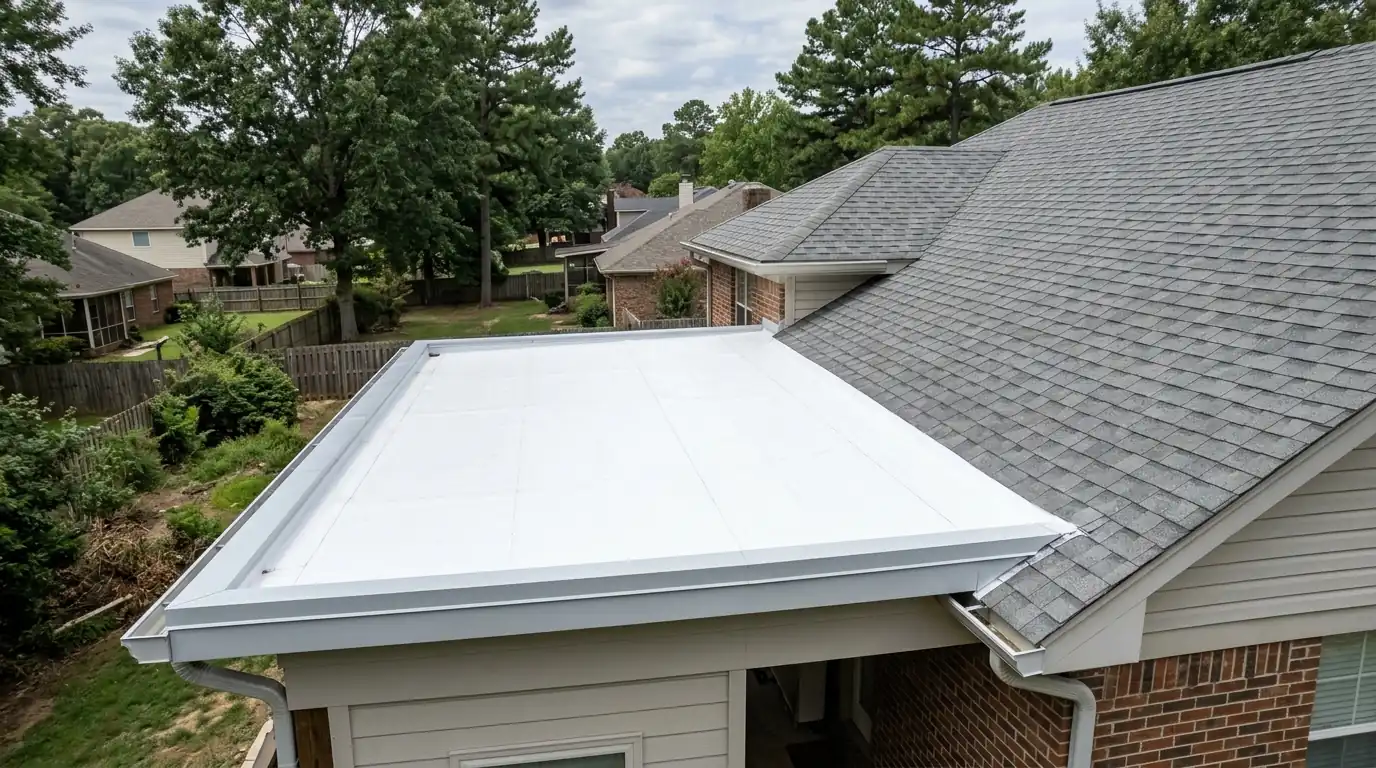
The field of a TPO roof rarely fails. Problems show up at details: inside and outside corners, pipe penetrations, curbs and wall flashing. These are the places where crews rush, and where we slow down.
We use factory molded corners and boots where they fit, weld every flashing seam, and terminate wall flashing with a bar and counterflashing rather than relying on sealant alone. Edge metal is fastened on a tight pattern because straight-line winds peel roofs from the edge first.
Walk pads go along service paths to rooftop HVAC units. Technicians walking the same route for years will wear through membrane, and a few feet of walkway pad is cheap protection against that wear.
Many Little Rock homes have a low slope section that was originally roll roofing or tar and gravel and has leaked on and off for years. TPO is a strong replacement for these areas because it handles low pitch, sheds water well when properly sloped, and reflects heat away from the rooms below.
Where a flat section meets a shingled roof, we lap the TPO up under the shingles with proper flashing so water from the upper roof cannot back up at the joint. That transition is where many residential flat roofs leak, and getting it right matters more than the membrane brand.
White TPO can show dirt and leaf stains over time, especially under trees. That does not hurt performance, and a gentle cleaning during maintenance brings back much of the reflectivity.
TPO roofs do best with a check twice a year, ideally in spring after storm season and again in fall after leaves drop. We clear drains, look over seams and flashing, and patch any punctures from hail, fallen limbs or dropped tools by welding new TPO over the spot.
Manufacturer warranty terms depend on the product, membrane thickness and registration, and some require specific installation methods or inspections. We go over what applies to the system you choose and hand over the material paperwork when the job is finished.
You get a written price before work starts. Once the old roof is off, any wet insulation or soft decking is photographed and priced before we replace it.
TPO roofs are priced by square foot, with the total shaped by insulation, tear-off, and how many details the roof has.
| Job | Typical range | What drives it |
|---|---|---|
| TPO roof with tear-off, per sq ft | $7.40 to $11.80 | Membrane thickness, insulation and number of penetrations |
| TPO recover over existing roof, per sq ft | $5.85 to $8.90 | Only when existing roof is single layer and dry |
| Residential porch or addition in TPO | $2,450 to $6,300 | Size, tie-in to shingles and edge metal |
| Tapered insulation for drainage, per sq ft | $1.65 to $3.80 | Amount of slope needed toward drains |
| TPO repair or puncture patch | $365 to $940 | Number of spots and access to the roof |
Wet insulation found during tear-off, extra rooftop units and tall parapet walls are the most common reasons a TPO price moves. See the full roof pricing guide.
How the job goes
We look at the existing roof, take moisture readings, and check drains and slope before recommending tear-off or recover.
Old roofing comes off, damaged decking is replaced, and polyiso or tapered insulation goes down.
TPO is fastened or adhered, then every seam is hot air welded and probed.
Walls, curbs, pipes and drains get welded TPO flashing, and metal edge or coping is fastened tight.
Walk pads go along service paths, the site is cleaned, and we share photos of seams and details.
Lifespan depends on membrane thickness, installation quality, drainage and upkeep. A well installed TPO roof with good details, clear drains and twice a year checks can last many years. Heat and UV are tough on any roof here, and the white surface helps by keeping membrane temperatures lower than dark roofs. Manufacturer terms depend on the product and registration.
Often, yes. TPO handles low slopes, reflects heat away from the rooms below, and has welded seams that resist ponding water. The key detail on homes is the joint where the flat section meets the shingled roof, which needs proper flashing laps. We pay close attention to that transition on every residential TPO job.
Sometimes. A recover is possible when the existing roof is a single layer, dry, and the deck below is solid. Building codes limit the number of roof layers, and wet insulation must come out. We take moisture readings first and give you a written price for tear-off and, where it applies, for a recover so you can compare.
TPO is usually white and its seams are hot air welded into one sheet. EPDM is a black rubber membrane with seams joined by primed tape or adhesive. White TPO reflects more summer heat, while EPDM is very flexible and has a long track record on low slope roofs. Both work well when installed with care.
We clean the area around the puncture, prepare the surface, and hot air weld a new piece of TPO over it so the patch becomes part of the membrane. If water got under the membrane, we check the insulation below and replace any wet sections. Most TPO puncture repairs take less than a day in dry weather.
Related work
Leaks, ponding water, split seams and failed drains fixed on low slope roofs for homes, porches, offices and small commercial buildings.
How we handle itFlexible black rubber membrane for low slope roofs, installed in wide sheets with taped seams, plus repairs for aging EPDM.
How we handle itRepair, replacement, coatings and planned maintenance for offices, retail centers, churches and warehouses across central Arkansas.
How we handle itSilicone and acrylic coatings that restore sound flat and metal roofs, applied by our crews after proper cleaning and repairs.
How we handle itTalk to a roofer nowCall and describe what you are seeing. We answer around the clock.
Call (501) 387-1152