Roof Leak Repair
We follow the water back to where it actually gets in, fix that spot and stop the stain from coming back.
How we handle itBungalow Roof Leak Repair
Capitol View and Stifft Station grew up in the 1920s and 1930s, and their bungalows still have the low eaves and tight porch tie ins that leak first. We repair and reroof them without losing their character.
Capitol View/Stifft Station in 72205 has about 1,500 homes between West Markham and I-630, mostly Craftsman bungalows built in the 1920s and 1930s. Our work here centers on leaks at porch roofs, rafter tail rot, chimney flashing and full tear offs over board decking. Repairs usually run $330 to $1,290, and reroofs often land between $9,900 and $18,600. Call (501) 387-1152.
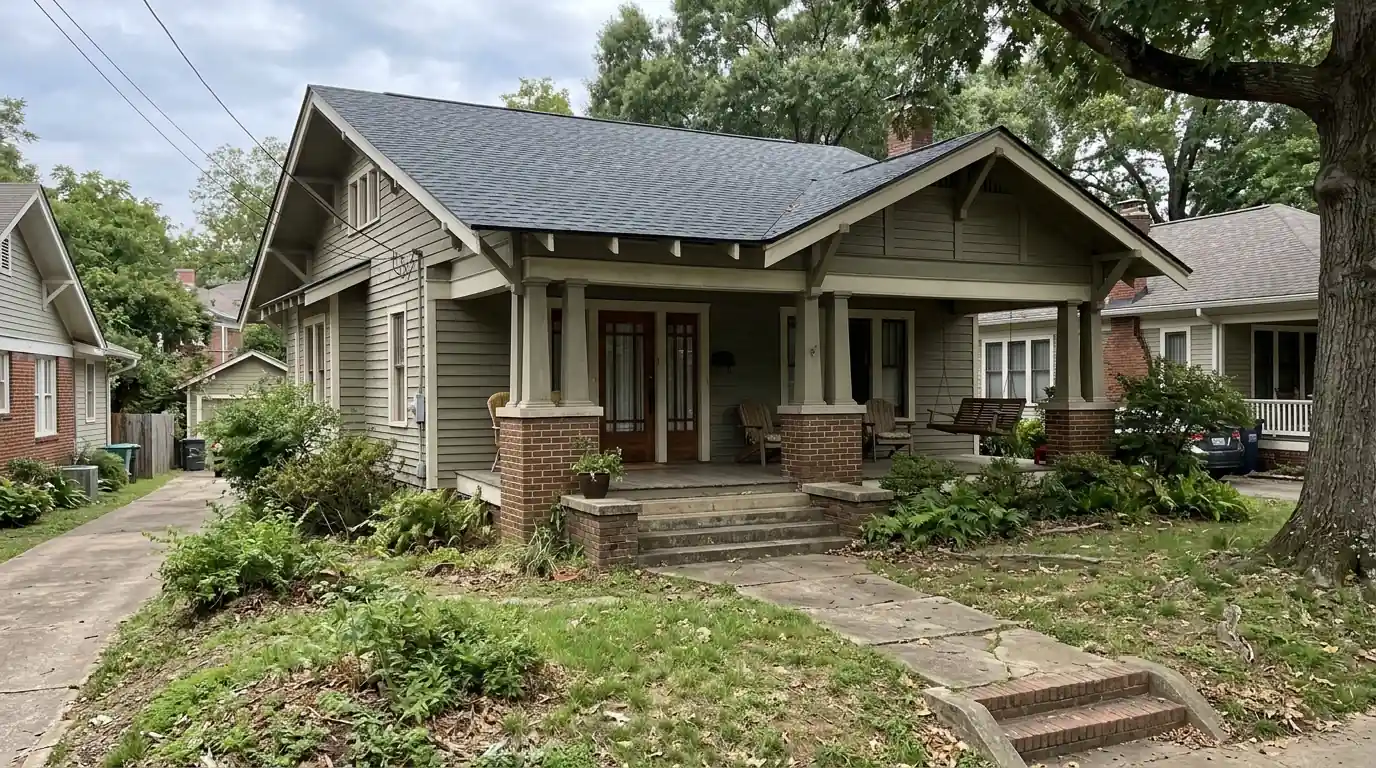
Capitol View and Stifft Station sit just west of downtown, roughly between West Markham Street and I-630, from Summit Street out to Pine. The neighborhood grew with Little Rock's push west in the early 1900s, and about 40 percent of its buildings went up in the 1920s alone, with more in the 1930s.
Two National Register districts cover much of it. The Capitol View Neighborhood Historic District was listed in 2001, and the Stifft Station Historic District sits beside it. Craftsman bungalows dominate, many with Tudor or Colonial Revival touches, mixed with shotgun houses, Foursquares, a few Queen Annes and some Spanish Colonial Revival homes.
Lamar Porter Field, a WPA era ballpark, anchors the area, and old hardwoods shade many of the side streets around it.
Bungalow roofs are low and wide on purpose. Deep overhangs with exposed rafter tails shade the porch and walls, and gentle pitches keep the house looking grounded. The downside is that water moves slowly on those slopes, and the exposed rafter ends soak up every drip that runs past the drip edge.
We find a lot of rafter tails here with rot at the ends, often hidden behind a gutter that was added decades later. Where the damage is shallow we cut back and splice new ends to match the profile. Where the rot runs deep, we sister new lumber alongside the old so the eave keeps its look.
Shingles on these pitches need careful underlayment. We use ice and water membrane along the eaves and in every valley, since a slow rain on a low pitch gives water plenty of time to find a gap.
Most leak calls here come from a small set of spots. Knowing them saves time on the roof and on your ceiling.
Many of these leaks show up far from where the water enters. On low pitch bungalow roofs, water can travel several feet along a rafter before it drips, so we trace from the attic side as well as from the roof.
Many homes here sit on narrow lots with houses close on both sides, sometimes with a shared driveway. We stage material and dumpsters so neighbors can still get in and out, and we tarp side yards to catch debris before it lands on the next roof or in someone's garden.
Tear offs on 1920s houses often turn up board decking with gaps and old nail holes, and sometimes two or three layers of shingles. We replace bad boards and add plywood sheathing where the planks are too far gone, then dry in each section before the crew leaves for the day.
The National Register listing does not restrict materials. Still, a dark charcoal or weathered wood shingle tends to suit a bungalow better than a bright color, and we bring samples so you can see them against your siding.
West Markham Street carries a band of shops and small commercial buildings through the middle of Capitol View. Several have flat or low slope roofs behind parapet walls, and we handle those as well, from membrane patches and drain clearing to full TPO or modified bitumen replacements.
Most bungalows here run 1,100 to 1,700 square feet, so the roofs are modest in area. That keeps replacement costs lower than in west Little Rock, but the extra work of older framing can add up.
A typical full reroof ranges from $9,900 to $18,600. Plywood overlay on board decking, rafter tail repair, multiple layers and a porch membrane are the most common line items that push a job toward the upper end. We list every item separately on your written price, so you can see exactly what each part costs.
Most requested in Capitol View/Stifft Station
We follow the water back to where it actually gets in, fix that spot and stop the stain from coming back.
How we handle itA complete tear-off to the deck with new underlayment, flashing, vents and shingles, finished in a day or two on most homes.
How we handle itRotted fascia and soffit boards replaced, vents restored and gaps sealed so water, squirrels and birds stay out of the roof edge.
How we handle itNew covered patios, porch roof rebuilds and leak repairs, framed and tied into the main roof so water runs away from the house.
How we handle itReplacement of failed step, apron, counter and vent flashing where roofs meet walls, dormers, skylights and pipes.
How we handle itRotted, soft or delaminated roof sheathing cut out and replaced so new shingles or metal have a solid base to fasten into.
How we handle itNo. Both the Capitol View and Stifft Station districts are National Register listings, which honor the area's history but do not restrict roofing materials or colors. You can choose the shingle you want. Many owners still pick darker, matte colors that suit 1920s bungalows, and we bring samples so you can compare them against your siding and trim before deciding.
Yes. Rafter tail rot is one of the most common problems on Capitol View/Stifft Station bungalows. We cut out the damaged ends and splice in new wood shaped to match the original profile, or sister new lumber alongside when rot goes deeper. Most homes need a handful repaired, typically $85 to $210 per tail depending on access.
Most Stifft Station bungalows are reroofed in one or two days. Extra decking repair, rafter work or several old layers can stretch that by a day. We open only what we can dry in before the crew leaves, so the house is never exposed overnight, and finish with cleanup and a magnet sweep for nails across your yard and the neighbor's side.
On the low pitch roofs common in Capitol View, slow steady rain gives water time to wick sideways under shingles, especially at porch tie ins, valleys and old flashing. Short storms may never reach that point. The fix is usually new flashing and ice and water membrane at the problem area. We trace the path from the attic and the roof before quoting.
Roof trouble in Capitol View/Stifft Station?Call any hour. A person answers and books the first open crew.
Call (501) 387-1152