Seamless Gutter Installation
New aluminum gutters roll-formed on site in one continuous piece per run, with downspouts placed to move heavy rain away.
How we handle itGutters, siding & exterior
The right gutter guard depends on what falls from your trees. We install micro-mesh, perforated metal and screen guards matched to the pine needles, oak leaves and seed pods common across Little Rock and central Arkansas.
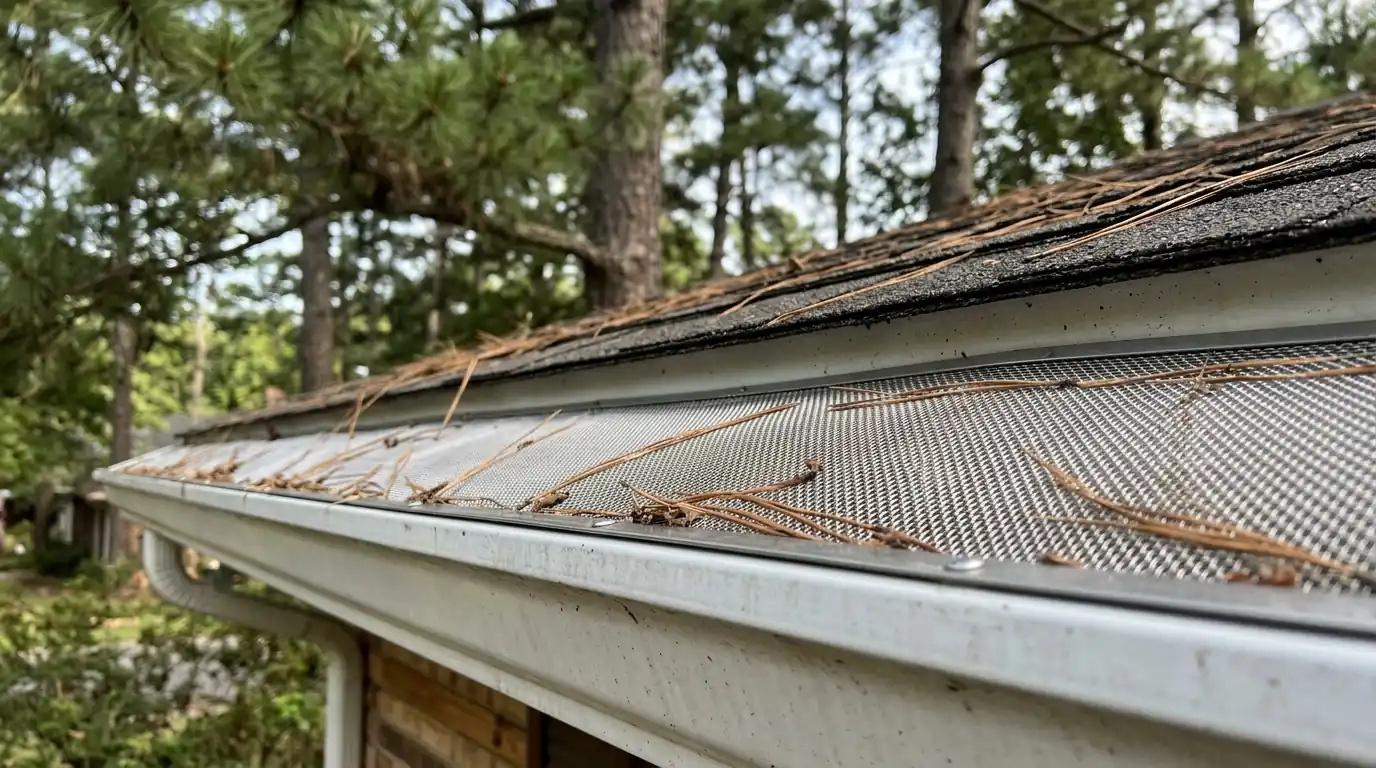
Gutter guards are covers that let rain into the gutter while keeping leaves, needles and debris out. Typical Little Rock installs run $6.40 to $14.80 per linear foot depending on guard type, or about $1,180 to $2,960 for most homes. Installation on existing gutters usually takes a single day, including a full cleanout first.
A guard that works perfectly under a maple can fail under a loblolly pine. Pine needles are thin and stiff, so they slip straight through coarse screens and lodge in the openings like pins in a cushion. Oak leaves are broad and slide off most guards, but the catkins oaks drop in spring are fine enough to mat on top of a fine mesh.
Central Arkansas yards often have all of these at once, plus sweetgum balls and maple seeds. Before recommending anything, we look at which trees overhang your roof, how close they are, and which side of the house takes the heaviest drop.
Sweetgum trees deserve their own mention. Their spiky seed balls bounce off most guards, but without a guard they roll straight to the downspout opening and wedge there, which is why so many central Arkansas homes have downspouts that clog every fall no matter how often the gutters are cleaned.
There is no single best guard. Each design handles certain debris well and others poorly, and the price follows how much material and labor each one needs.
For homes surrounded by pines, a stainless micro-mesh guard over a rigid frame is usually the right call because the openings are too small for needles to enter. Under mostly oaks and hardwoods, a sturdy perforated aluminum guard sheds broad leaves well at a lower cost. Light tree cover or a tight budget can be served by a heavy screen guard, with the understanding that it will need more brushing off.
We also steer people away from foam inserts and brush-style guards on wooded lots. They are cheap and easy to install, but needles and seed pods get trapped inside them, and they can end up holding more debris than an open gutter would.
Some guards slide under the first row of shingles, and others fasten only to the gutter and fascia. Lifting shingles to tuck a guard underneath can break the seal strips on some roofs and affect the shingle warranty depending on the manufacturer's terms.
Where possible, we use guards that attach to the front lip of the gutter and the drip edge without disturbing the shingles. The guard sits at a slight angle so debris dries and blows off instead of resting flat in a wet mat.
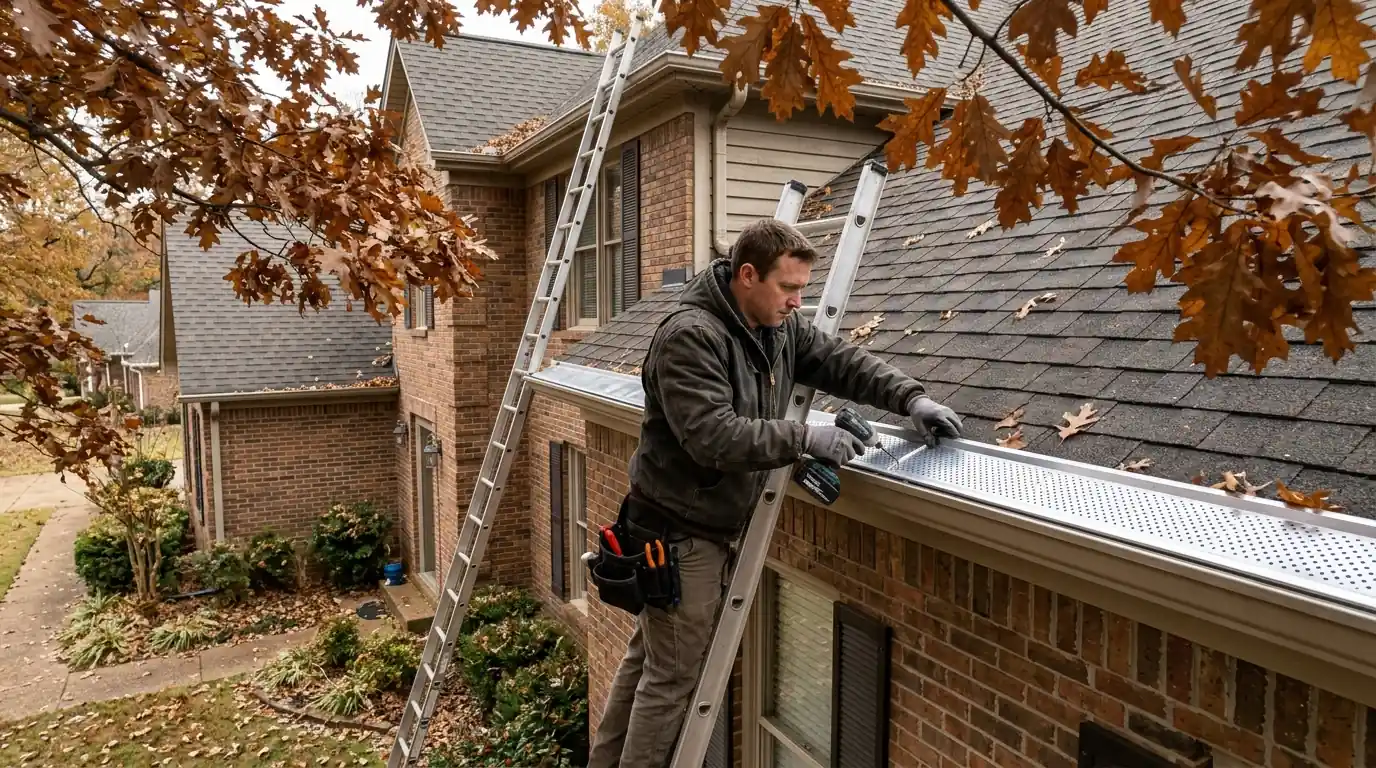
A guard that blocks leaves but cannot take in water during a downpour is a problem. Spring and early summer storms around Little Rock can bring very heavy rain in short bursts, and a guard with too little open area lets water sheet right over the front of the gutter.
We choose guards rated to handle high rainfall and pay attention to valleys where water from two roof planes meets. Those corners often need extra open area or a small diverter so the gutter below them keeps up.
Summer humidity is the other factor. Wet debris resting on a guard can grow algae and moss on shaded sides. Guards set at a gentle angle dry faster, and an occasional rinse with a garden hose keeps the mesh open.
Roof pitch plays a part as well. Water off a steep roof hits the gutter edge with more speed, and on those homes we may set the guard at a different angle or choose a design that slows water at the front lip so it drops in rather than racing past.
Guards go on clean, sound gutters only. We clean out every run, flush the downspouts and check for sags, loose hangers and leaking corners before a single guard is installed.
If a run is sagging or pitched wrong, we fix it first, because covering a gutter that holds water just hides the problem. Any repairs found during prep are priced in writing before we do them. Homes with old, failing gutters may be better served by new gutters with guards installed at the same time.
Downspout size matters even with guards in place. Fine grit and small debris still reach the downspout, and a narrow 2 by 3 inch spout clogs sooner than a 3 by 4 inch one. On heavily wooded lots we often suggest upsizing downspouts during the same visit.
No guard makes gutters maintenance-free forever. Even the best micro-mesh can collect a layer of pollen, oak catkins or pine debris on top. In most yards that blows off or washes away, but heavy tree cover may still need a quick brushing or rinse once or twice a year.
The difference is that you are clearing the top of a guard from a ladder in minutes rather than digging packed, wet debris out of the gutter and flushing clogged downspouts. That is a big change for homes under the tall pines common across central Arkansas.
We also recommend a look at the downspout outlets each spring. A guard keeps most debris out, but fine grit from shingles can collect at the bottom of a downspout over time.
Gutter guard prices in central Arkansas depend mostly on guard type and home height. These are typical 2026 ranges.
| Job | Typical range | What drives it |
|---|---|---|
| Heavy screen guards per linear foot | $6.40 to $8.90 | Home height and number of corners |
| Perforated aluminum guards per linear foot | $8.20 to $11.60 | Gutter size and attachment method |
| Stainless micro-mesh guards per linear foot | $10.80 to $14.80 | Frame quality and two-story access |
| Pre-install cleanout and minor repairs | $145 to $460 | Debris load and number of repairs found |
| Typical single-story home, micro-mesh | $1,640 to $2,960 | Total footage and valley details |
Guard type, second-story runs and how much repair the existing gutters need set the final price. See the full roof pricing guide.
How the job goes
We note which trees overhang each side of the house and what debris they drop in each season.
You get a written price for the guard type that fits your trees and budget, with reasons.
Every gutter is cleaned, downspouts flushed, and sags or leaks fixed before guards go on.
Guards are cut to fit each run and fastened to the gutter lip and drip edge.
We run water over the guards, especially at valleys, to check that rain gets in.
Stainless micro-mesh guards on a rigid frame work best for pine needles because the openings are too small for needles to enter. Coarse screens let needles poke through and lodge, which can be worse than no guard. Since loblolly and shortleaf pines are common around central Arkansas, micro-mesh is the guard we recommend most often for wooded lots.
Yes. Broad oak leaves slide off most quality guards, and perforated aluminum handles them well at a lower cost than micro-mesh. The catch is spring, when oaks drop catkins and pollen that can mat on fine mesh. A quick brushing or hose rinse after that drop keeps the guard taking in water.
Good guards are designed with enough open area to take in heavy rain, but cheap solid covers and reverse curve hoods can overshoot in a hard downpour. We pick guards rated for high rainfall and give extra attention to valleys where water concentrates. A hose test after installation shows how each run handles a strong flow.
In most cases, yes, as long as the gutters are sound, properly pitched and firmly attached. We clean and inspect them first and fix any sags or leaking corners before installing guards. If the gutters are old, rusted or pulling loose along most of the house, it usually makes more sense to install new gutters and guards together.
It depends on the guard and the shingle manufacturer's terms. Guards that slide under shingles can break seal strips, which some manufacturers frown on. We usually install guards that fasten to the gutter lip and drip edge so the shingles are not disturbed. Check your shingle warranty paperwork, and we can help you read it.
Related work
New aluminum gutters roll-formed on site in one continuous piece per run, with downspouts placed to move heavy rain away.
How we handle itRehang sagging runs, seal dripping corners, reset pitch and reattach downspouts so your existing gutters work again.
How we handle itA yearly or twice-yearly tune-up that clears debris, reseals weak spots and fixes small problems before they turn into ceiling stains.
How we handle itRotted fascia and soffit boards replaced, vents restored and gaps sealed so water, squirrels and birds stay out of the roof edge.
How we handle itTalk to a roofer nowCall and describe what you are seeing. We answer around the clock.
Call (501) 387-1152