Roof Flashing Repair
Replacement of failed step, apron, counter and vent flashing where roofs meet walls, dormers, skylights and pipes.
How we handle itRoof repair
A chimney leak can come from four or five different places, and the flashing is only one of them. Before anyone smears roof cement around the base, the real source needs to be found.
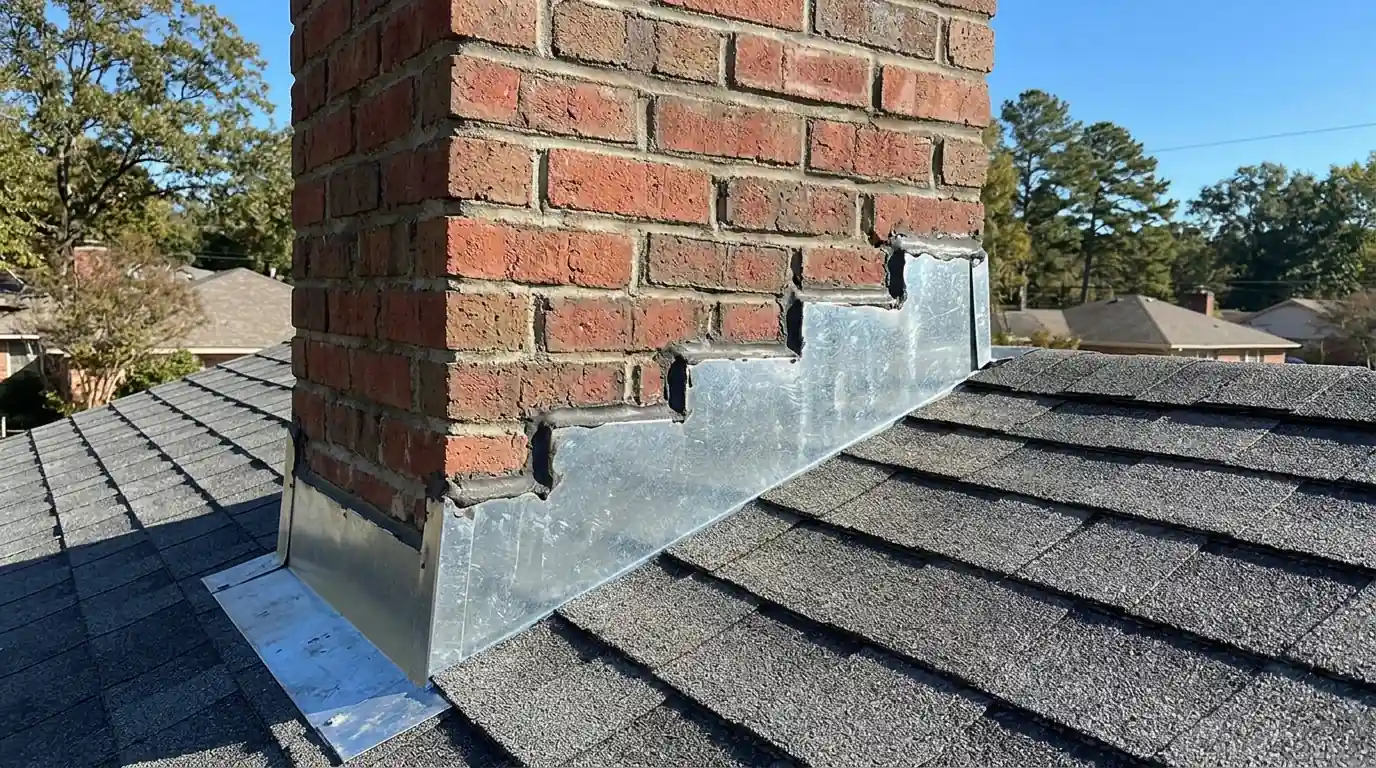
Chimney leak repair stops water entering where a chimney passes through the roof, by fixing flashing, counterflashing, the crown, a missing cricket or porous brick and mortar. In Little Rock, typical chimney leak repairs cost $385 to $1,860, with full reflashing and a new cricket reaching $2,940. Most repairs take one or two days.
Water that shows up on a ceiling or wall next to a chimney can enter at several points. The flashing around the base is the most common, but the top of the chimney, the brick itself and the roof area behind the chimney all cause leaks too. Fixing the wrong one means the stain comes back after the next storm.
We check each possible source in order, starting from the top of the chimney and working down, because water entering high up can travel inside the chimney and appear at the base, looking exactly like a flashing leak.
A cricket, sometimes called a saddle, is a small peaked roof built on the uphill side of a chimney. It splits water flowing down the slope and sends it around the chimney instead of letting it pool against the back. Wider chimneys especially need one, and many older homes were built without it.
Without a cricket, water and debris pile up against the back of the chimney. Leaves and pine needles collect there, hold moisture and wear out the flashing and shingles faster than anywhere else on the roof. That uphill side is one of the most common leak points we find on Little Rock chimneys.
Adding a cricket involves framing a small structure, sheathing it, installing underlayment and then flashing and shingling it into the roof. It is a bigger job than resealing, but it removes the cause instead of treating the symptom.
A chimney that has been leaking for a while can also leave damage beyond the stain you see. Framing around the chimney chase, the decking at its base and insulation in the attic can all hold moisture, so we look at those areas closely during every chimney inspection.
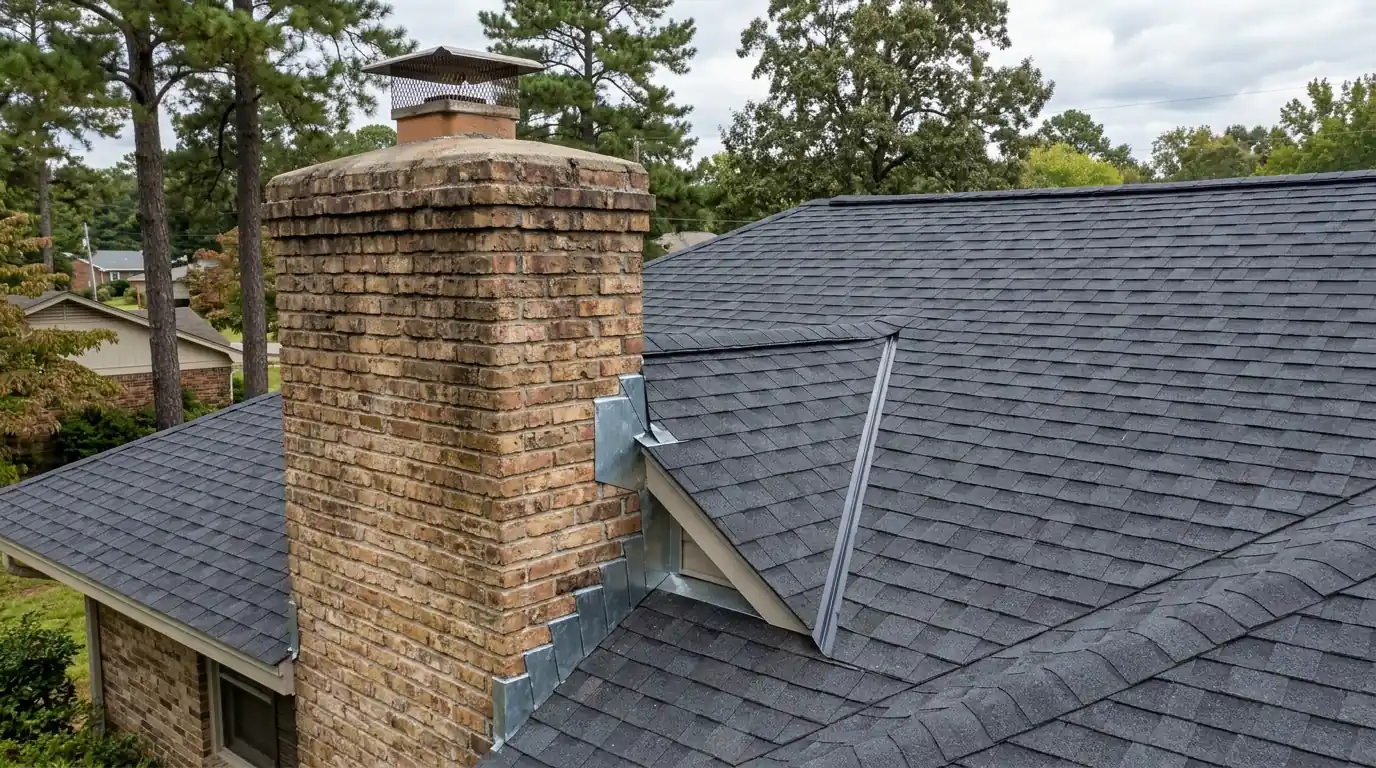
Brick and mortar are more porous than many homeowners realize. Wind-driven rain soaks into old brick and soft mortar joints, and that water can work its way down inside the chimney to the roof line. If flashing looks sound but the leak persists, the masonry is often the culprit.
The crown, the concrete or mortar cap on top of the brick, sheds water off the chimney top. Crowns crack with age and freeze-thaw cycles, letting water straight into the masonry. A metal chimney cap over the flue keeps rain, debris and animals out of the chimney itself.
Our crew handles the roof side of chimney leaks, including flashing, counterflashing, crickets, crowns and caps. If we find structural masonry problems that call for a mason, such as a leaning chimney or brick that needs rebuilding, we tell you that plainly and explain what we saw.
Metal chimney chases, common on homes with prefabricated fireplaces, have their own weak point: the flat metal chase cover on top. Those covers rust and pool water over time, especially when they were built without a slight slope, and a rusted chase cover can send water straight down the inside of the chase.
Summers in Little Rock put chimney flashing through daily heat cycles. Metal expands in the afternoon sun and contracts at night, while the brick moves at a different rate. Over years, that movement loosens counterflashing and cracks any sealant at the joint between metal and masonry.
Spring storm season, roughly March to June, then drives rain sideways into those gaps. Many chimney leaks only appear during wind-blown downpours, which is why homeowners sometimes go months without a sign and then see a stain after one severe storm.
Winter freeze-thaw cycles are hard on crowns and mortar. Water soaks into small cracks, freezes, expands and widens them. Occasional ice storms make this worse, and a crown that was hairline-cracked in fall can be letting in real water by spring.
Once we have traced the source, the repair matches it. For flashing leaks, we remove the shingles around the chimney, take out the old step and apron flashing and install new pieces woven into each course. Counterflashing is cut into a mortar joint with a grinder and sealed, rather than glued to the face of the brick.
Crown cracks are sealed or the crown is rebuilt depending on condition. Missing caps are replaced. For porous brick, a breathable masonry water repellent can reduce absorption. Where a cricket is needed, we frame and flash one into the roof.
You get photos of the old flashing or crown and the finished repair, along with a clear explanation of what caused the leak.
If the chimney is no longer used, some homeowners ask whether it makes more sense to remove it below the roof line and deck over the opening. That can be a good option in some cases, and we can talk through what it involves and how it compares with a full repair.
Chimney leak repair cost depends on which source we find and how large the chimney is. These are typical 2026 Little Rock ranges.
| Job | Typical range | What drives it |
|---|---|---|
| Counterflashing reset and seal | $385 to $790 | Chimney width and mortar condition |
| Full chimney reflashing | $865 to $1,860 | Chimney size, pitch and shingle type |
| Crown seal or repair | $345 to $1,140 | Crack size or full rebuild needed |
| Chimney cap installation | $265 to $640 | Flue size and cap material |
| Cricket framing and flashing | $1,180 to $2,940 | Chimney width and roof pitch |
Chimney width, roof pitch, mortar condition and whether a cricket is needed change the price most. See the full roof pricing guide.
How the job goes
We check the cap, crown, brick, mortar and flashing, starting at the top of the chimney.
We look at framing and decking around the chimney from the attic to find water paths.
You see the source of the leak in photos and get a written price before work.
Our crew reflashes, cuts in counterflashing, seals or rebuilds the crown or adds a cricket.
We clean up, run a magnet sweep for nails and walk you through what was fixed.
Usually because sealant was used instead of proper flashing, or because the leak comes from somewhere else. Roof cement and caulk around a chimney crack after a hot Arkansas summer or two. If the crown, brick or a missing cricket is the real source, sealing the base will never stop it. We trace from the top down before repairing.
Chimneys wider than about 30 inches across the uphill side generally benefit from a cricket, and many building guidelines call for one. Without it, water and debris pool behind the chimney and wear out flashing quickly. If your chimney is wide and keeps leaking at the back, adding a cricket often solves it for good.
Yes. Brick and mortar are porous, and wind-driven rain during severe storms soaks into them. Older homes with soft mortar are especially prone. That water can travel down inside the chimney and appear at the roof line or on a ceiling. A breathable masonry water repellent and mortar repair can reduce how much soaks in.
Often both, but most chimney leaks are on the roofing side: flashing, counterflashing, crickets, crowns and caps. Our crew handles those. If we find structural masonry problems like a leaning chimney or brick that needs rebuilding, we explain what we saw so you can bring in a mason for that part.
Most chimney leak repairs here run $385 to $1,860 depending on the source. Resetting counterflashing is at the lower end, while full reflashing sits higher. Adding a cricket behind a wide chimney can run $1,180 to $2,940. You get a written price with photos of the problem before any work begins.
Related work
Replacement of failed step, apron, counter and vent flashing where roofs meet walls, dormers, skylights and pipes.
How we handle itWe follow the water back to where it actually gets in, fix that spot and stop the stain from coming back.
How we handle itA hands-on roof and attic check with labeled photos, an honest remaining life estimate and a written price for any repair needed.
How we handle itTargeted fixes for worn shingles, failed flashing, cracked pipe boots and soft spots, priced in writing before our crew touches the roof.
How we handle itTalk to a roofer nowCall and describe what you are seeing. We answer around the clock.
Call (501) 387-1152