Storm Damage Roof Repair
Full roof assessment after a severe storm, covering debris impacts, mixed hail and wind damage, gutters and the attic below.
How we handle itRoof repair
Wind damage hides in plain sight. A shingle that lifted for a few seconds in a gust and fell back down can look normal from the yard, but its seal is broken and the next storm will finish the job.
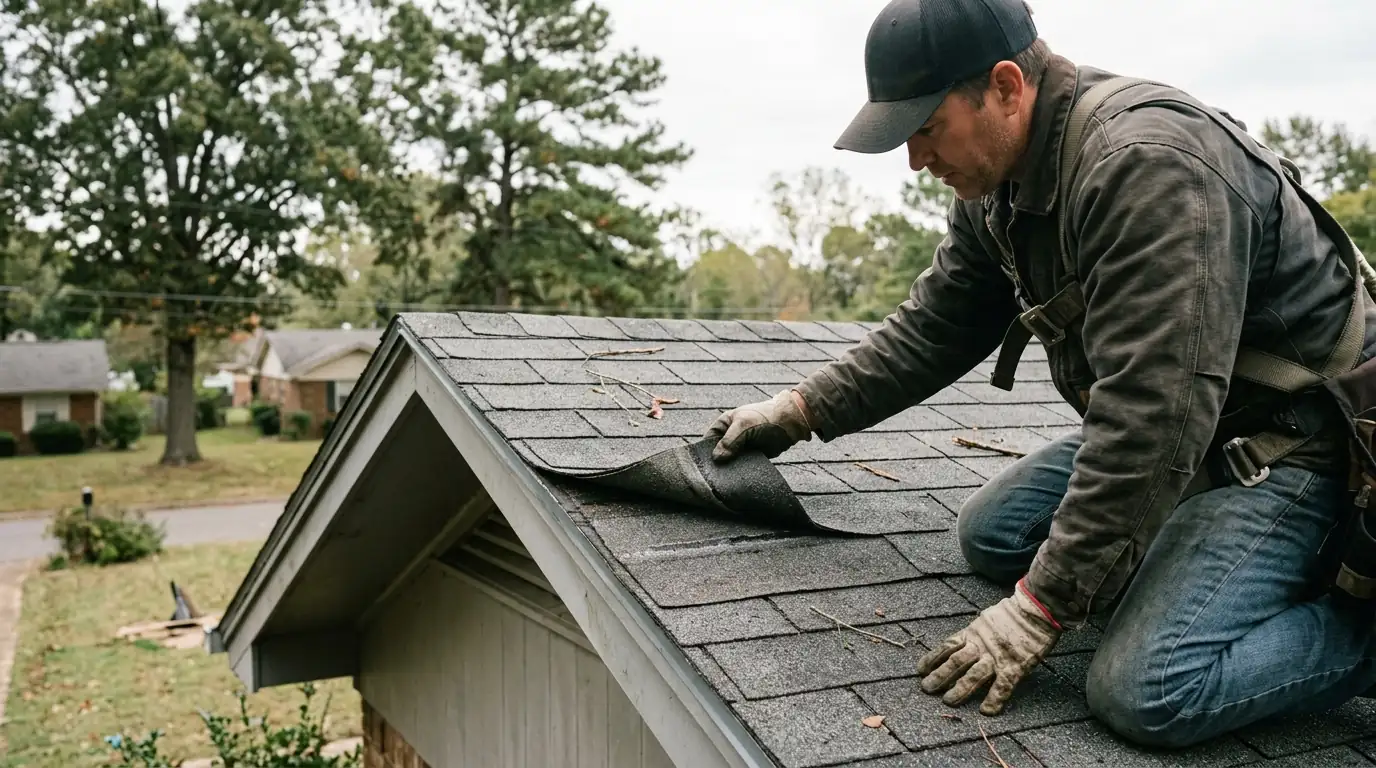
Wind damage roof repair replaces or reseals shingles that were lifted, creased or torn off by high winds, along with damaged ridge caps, rake edges and flashing. Typical Little Rock wind repairs cost $345 to $1,480 for most homes, more if decking is exposed. Many repairs are completed in a single day once the damage is mapped.
Asphalt shingles are held down by nails and by a strip of sealant that bonds each shingle to the one below it. Wind pulls at the exposed edge of a shingle, and if the gust is strong enough or the sealant is weak enough, the shingle lifts and bends back. When it drops, the seal is broken and there is often a crease across it.
That creased, unsealed shingle is the classic wind damage most people never see. It is still on the roof, but it is no longer sealed down, and it flaps in every breeze afterward. Over time the nails work loose or the shingle tears at the crease and blows off.
Wind does the most damage at the edges of a roof: the rakes along the gable ends, the eaves, the ridge and the hips. Those are the spots where airflow speeds up and suction is strongest, so they are where our inspection starts.
Wind damage looks different from hail or general wear. These are the specific clues we check on each slope.
We start by working out where the wind came from. Debris patterns in the yard, the side of the house where siding or screens were hit and the direction trees fell all point to the slopes that took the most force. Those slopes get the closest look.
On the roof, we do a gentle lift test on shingles along the edges and across each slope, checking whether the sealant strip is still holding. Lifting is done carefully, because forcing a sealed shingle can create the very damage we are looking for. Every creased, unsealed or missing shingle is marked and photographed.
We also look at the nailing. Shingles that were nailed too high or with too few nails when the roof went in are much more likely to blow off, and that tells us whether a spot repair will hold or whether the problem is built into the whole roof.
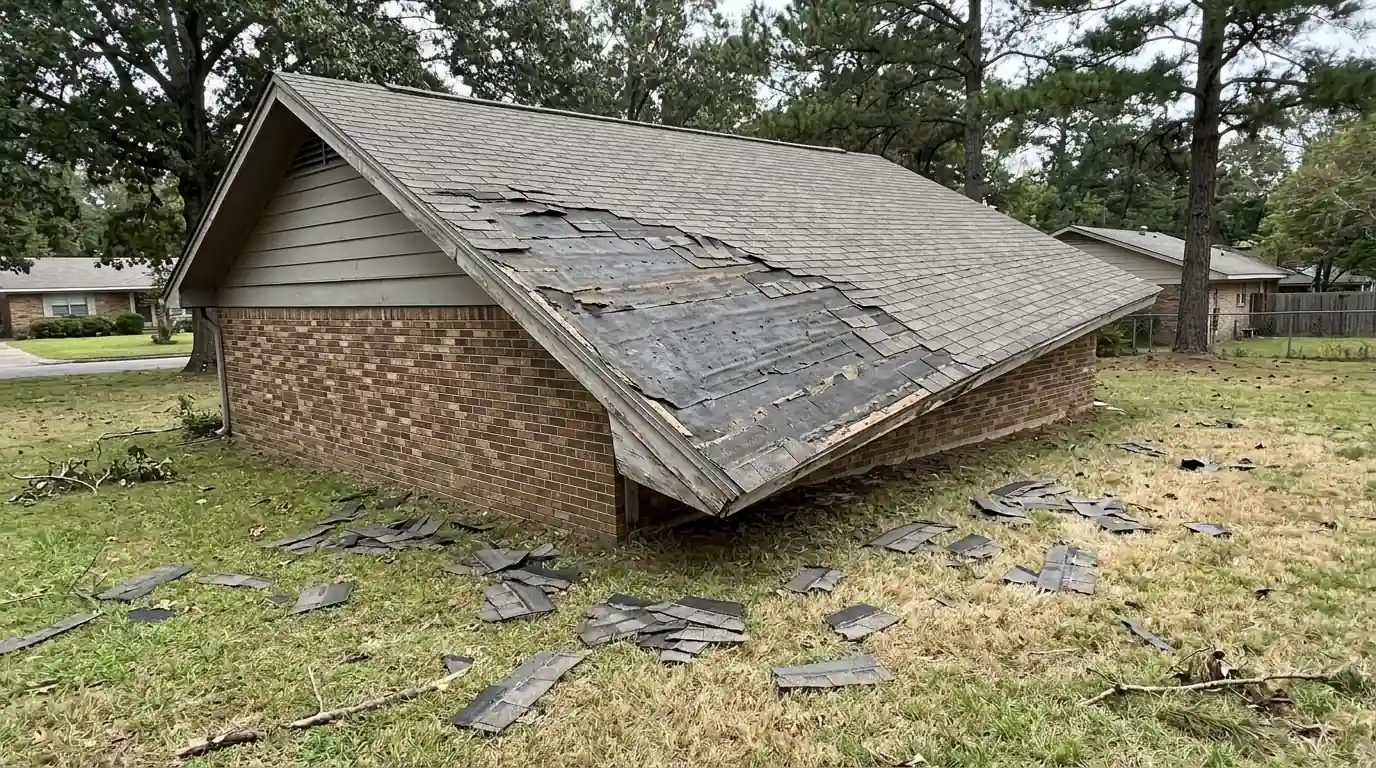
Most wind damage in the Little Rock area does not come from tornadoes. It comes from straight-line winds, the strong, outflowing gusts that rush ahead of and through severe thunderstorms. They can be as damaging as a weak tornado and cover a much wider area, flattening fences, dropping limbs and stripping shingles across entire neighborhoods.
Heat makes it worse. Long Arkansas summers dry out the sealant strips on asphalt shingles, and an aging roof can lose much of its bond strength without any sign from the ground. Then a spring or summer storm arrives, and a roof that has never had a problem loses a row of shingles along the rake.
Tornadoes are a real risk here as well. Even a home outside a tornado's path can see damage from the surrounding winds and debris. After any tornado warning in your area, it is worth a careful look at the edges of your roof.
Trees add to wind damage here. Tall loblolly pines and mature oaks are common across central Arkansas neighborhoods, and strong gusts snap limbs that land on roofs or drag across shingles as they fall, scraping off granules and tearing tabs well away from the roof edges.
Wind damage is usually covered as a sudden event, and many Arkansas policies group it with hail under a separate wind and hail deductible. Write down the date of the storm, take photos of anything blown into the yard and contact your carrier promptly.
Adjusters often look for creased and unsealed shingles as proof that wind, not age, caused the problem. Our photos show the creases, the broken sealant and the location of each damaged shingle, which helps separate fresh wind damage from long-term wear. Where a roof has old damage as well, we note that honestly in our report.
Replacing a blown-off shingle is only part of the job. We also replace the creased shingles around it, reseal any shingles that lifted but did not crease and fix the nailing where it was the cause. Ridge caps and rake edges get extra attention, since those take the strongest gusts.
If a large section has lost its seal, or if the original nailing is the problem across the whole roof, spot repairs may only last until the next storm. In that case we show you the evidence and price a slope or full replacement, using shingles with a higher wind rating where it makes sense. Manufacturer wind ratings depend on the product and installation method.
When we reseal lifted shingles, we use roofing sealant applied in measured dabs under the tab, not a heavy smear across the surface. Too much sealant traps water and looks messy, while too little lets the tab lift again, so the amount matters as much as the product.
Wind repair costs depend on how many shingles lost their bond and whether edges or decking were exposed. These are typical 2026 Little Rock ranges.
| Job | Typical range | What drives it |
|---|---|---|
| Replace blown-off shingles, small area | $345 to $860 | Number of shingles and color match |
| Reseal lifted shingles across a slope | $285 to $740 | Slope size and number of unsealed tabs |
| Ridge cap and hip repair | $365 to $1,080 | Length of ridge and ridge vent condition |
| Rake edge and drip edge repair | $410 to $1,480 | Linear footage and fascia condition |
| Exposed decking and underlayment repair | $720 to $2,650 | Area exposed and any water damage to wood |
Roof height, pitch, discontinued shingle colors and whether original nailing must be corrected change the price most. See the full roof pricing guide.
How the job goes
We use debris, siding damage and fallen limbs to find the slopes that took the most force.
We gently check sealant bonds along edges and slopes and mark every creased or unsealed shingle.
We look at nail placement and count to judge whether spot repairs will hold.
You get labeled photos of each damaged area and a written price before work starts.
Our crew replaces damaged shingles, reseals lifted ones and corrects nailing at edges and ridges.
Yes. Many wind-damaged shingles stay on the roof. A gust lifts the tab, breaks the sealant bond and leaves a crease, then the shingle falls back into place. From the ground it looks fine. Those shingles are much more likely to tear off in the next storm, so we lift test edges and slopes to find them.
It varies with the shingle, its age and how it was nailed. Newer shingles with strong sealant bonds handle gusts better than older, sun-dried ones. Manufacturer wind ratings depend on the product and installation method. In practice, the strong straight-line gusts in central Arkansas thunderstorms are often enough to lift shingles on older roofs.
Wind damage from a sudden storm is commonly covered, often under a separate wind and hail deductible in Arkansas. Coverage depends on your policy and the roof's condition. Report promptly, note the storm date and keep photos of debris. We document creased and unsealed shingles clearly, since adjusters use those to tell wind damage from age wear.
Repeated loss in one area usually points to nailing or sealant problems built into that section. Shingles nailed too high or with too few nails pull loose easily, and a slope facing the prevailing storm direction takes more force. We check the nailing pattern and sealant across the whole slope before deciding whether spot repair or slope replacement will last.
Soon, ideally before the next storm. Unsealed and creased shingles keep flapping in every breeze and often tear off completely in the next strong wind, which can expose underlayment and let water in. If shingles are already missing and rain is coming, call us at (501) 387-1152 and we can secure the area first.
Related work
Full roof assessment after a severe storm, covering debris impacts, mixed hail and wind damage, gutters and the attic below.
How we handle itTargeted replacement of cracked, curled, blistered or missing asphalt shingles, color matched and nailed the way the manufacturer specifies.
How we handle itHeavy-duty tarps anchored with wood battens and wrapped over the ridge to keep rain out until permanent repairs are done.
How we handle itA complete tear-off to the deck with new underlayment, flashing, vents and shingles, finished in a day or two on most homes.
How we handle itTalk to a roofer nowCall and describe what you are seeing. We answer around the clock.
Call (501) 387-1152