Emergency Roof Tarping
Heavy-duty tarps anchored with wood battens and wrapped over the ridge to keep rain out until permanent repairs are done.
How we handle itRoof repair
When water is dripping through a light fixture at 2 a.m. or a limb has punched through the roof, you need a person on the phone and a plan within minutes. We answer 24/7 and send our own crew as soon as it is safe.
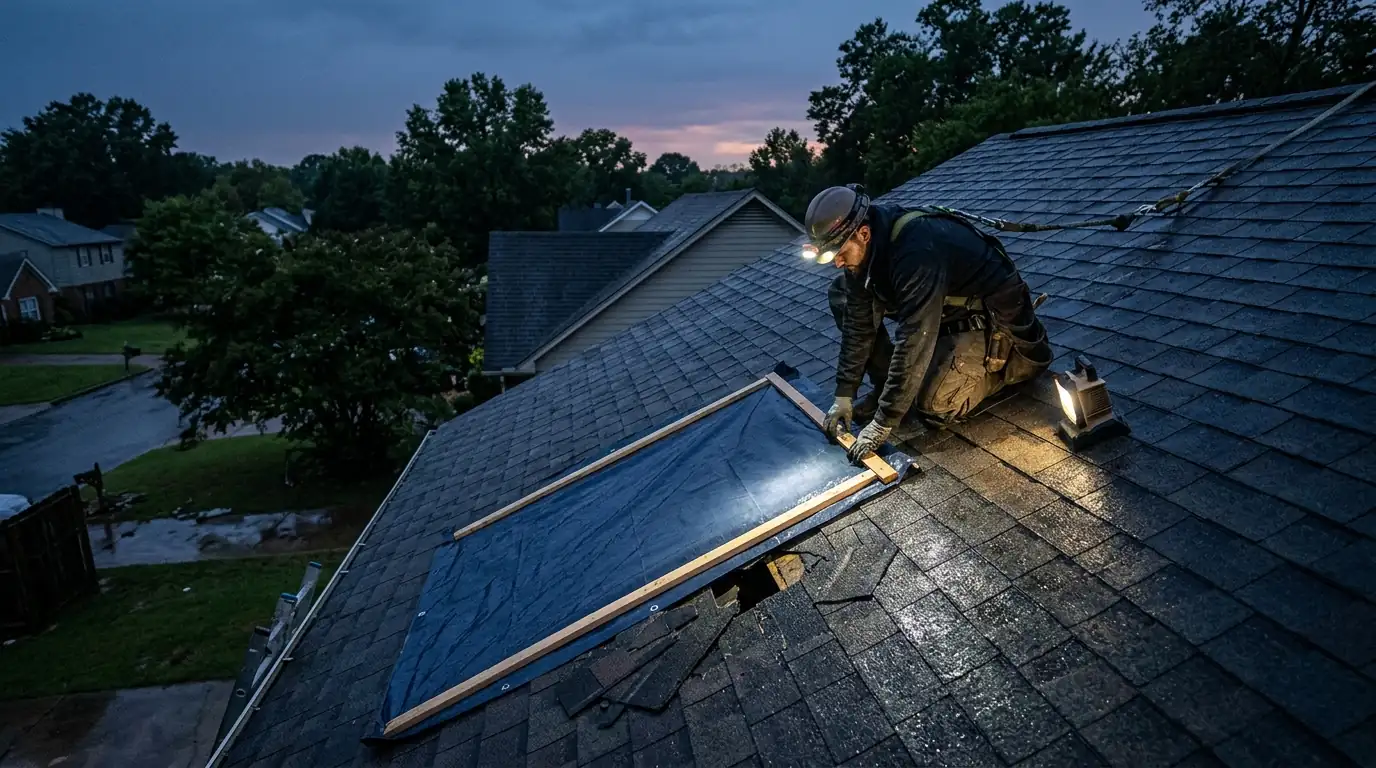
Emergency roof repair is urgent work to stop water entering a home after sudden damage, followed by a permanent fix. In Little Rock, the first emergency visit typically costs $395 to $1,240 depending on the hour, size of the opening and roof height. We answer 24/7 and dispatch our own crew once lightning and high wind have passed.
An emergency is anything that lets water into the living space or leaves the roof open to the next storm. A slow brown stain you noticed this week can usually wait for a regular appointment. Water running down a wall, a sagging ceiling or a hole you can see sky through cannot.
If you are not sure which one you have, call (501) 387-1152 and describe what you see. We will tell you honestly whether it needs a crew tonight or can be handled first thing in the morning.
Your safety comes before the roof. If a ceiling is bulging, keep people and pets out of that room. If water is near light fixtures or outlets, turn off that circuit at the breaker if you can do it safely, and never stand in water to reach a switch.
Move furniture, rugs and electronics away from the leak and set out buckets or towels. A small hole poked in the lowest point of a bulging ceiling with a screwdriver can drain trapped water in a controlled way, but only do that if you are comfortable and standing on dry ground.
Please do not climb onto a wet roof at night. Most of the serious injuries after storms happen to homeowners trying to cover a hole themselves. Take photos from the ground instead, because they help later with insurance.
Write down when the leak started and roughly how much water came in. Note any rooms affected and anything that got wet, such as carpet, drywall or stored boxes in the attic. That short record is far easier to put together the same night than to remember a week later.
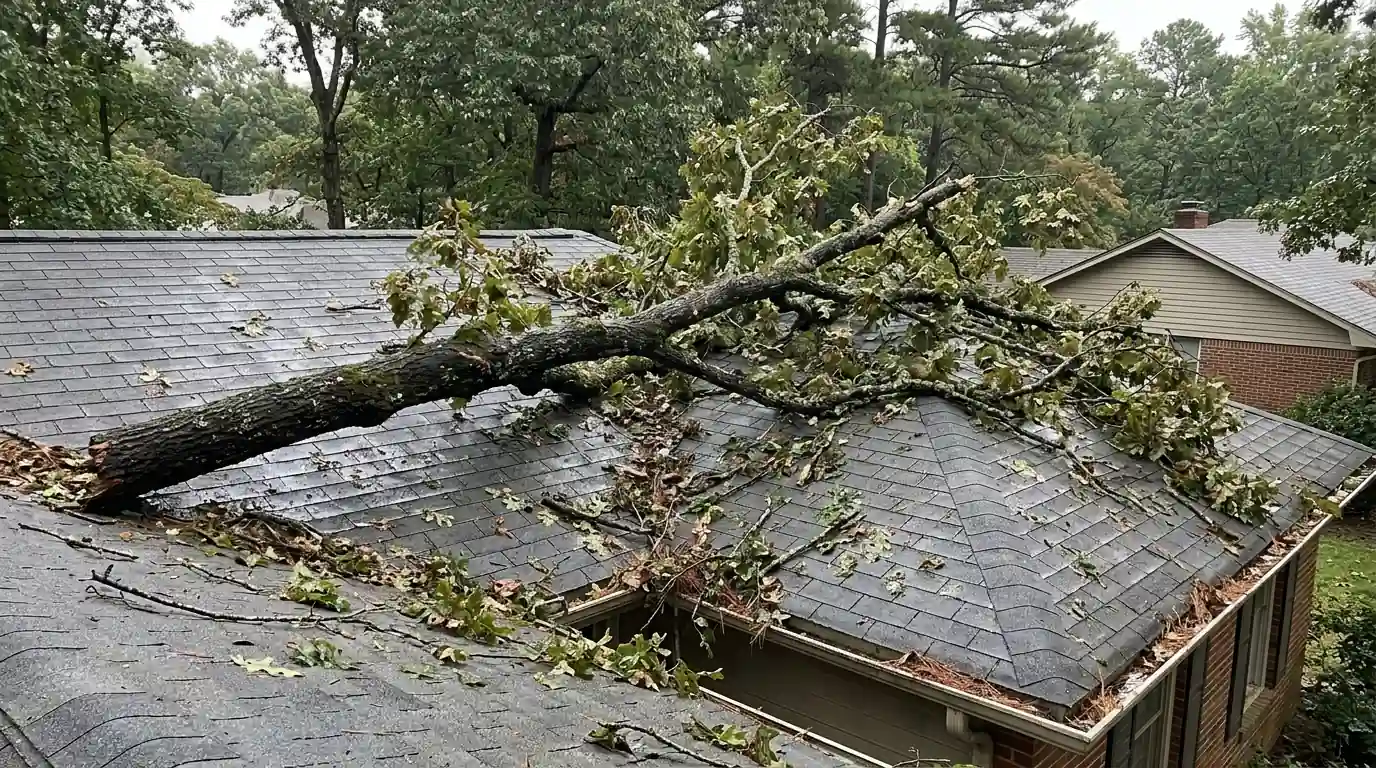
Our first job on an emergency call is to stop the water. Depending on the damage, that might mean sealing a lifted flashing seam, patching a punctured area with underlayment and shingles, or installing a secured tarp over a larger opening. If a limb is resting on the roof, we deal with what can be safely removed and protect the opening beneath it.
We photograph everything before and after, inside and out. Those photos, along with a written description of what we did, give you a clean record for your insurance adjuster.
Some emergency fixes are permanent on the spot. Others are a stabilizing repair that holds until materials can be matched and the full fix is scheduled. We tell you which one you have before we leave.
Inside, we check the attic for pooled water on insulation and wet framing. Soaked insulation can hold moisture against drywall for days, so we point out where it should be pulled back to dry. Catching that early is one of the simplest ways to keep a roof leak from turning into a mold problem.
The busiest emergency nights in Little Rock come during spring storm season, roughly March to June, when severe thunderstorms bring hail, straight-line winds and sudden downpours. Older pines and oaks drop heavy limbs, and roofs that were already sun-weakened by the previous summer give way at the edges first.
Lightning and high wind can make it unsafe to be on a roof even when a crew is ready. In those cases we stay on the phone, walk you through protecting the interior and get on the roof as soon as conditions allow. Occasional winter ice storms bring a different problem, with ice-laden branches breaking under the weight and landing on roofs overnight.
Tornado warnings add another layer. If the area is under a warning, our crew waits until it has expired and the storm has moved through before heading out. Once it is clear, calls are handled in order of severity, with open roofs and active water inside living spaces first.
Once the house is dry and protected, we come back in daylight for a proper assessment. That is when we check the decking from the attic, trace any water that traveled along rafters and decide whether the damaged area can be repaired or whether a slope or full roof needs replacing.
You get a written price for the permanent work, separate from the emergency visit. If your insurance is involved, that written scope and our photo set make the adjuster's job easier. Our crew does both the emergency work and the permanent repair, so nothing gets lost between two different companies.
Waiting too long on the permanent repair is the most common mistake we see after an emergency. A patch or tarp is built to buy time, not to last through a summer of Arkansas sun and the next round of storms. We schedule the permanent work as soon as materials and weather allow.
Emergency work costs more than a scheduled repair because of night hours, weather and urgency. These are typical 2026 Little Rock ranges for the first visit and the permanent fix that follows.
| Job | Typical range | What drives it |
|---|---|---|
| After-hours leak stop, small area | $395 to $780 | Time of night, roof height and access |
| Emergency patch over punctured decking | $560 to $1,240 | Size of the hole and whether decking must be cut back |
| Secured tarp over a large opening | $640 to $1,980 | Square footage covered and roof pitch |
| Limb removal from roof surface | $285 to $890 | Limb size and whether it can be cut and lowered by hand |
| Permanent repair after the emergency | $740 to $4,600 | Decking, rafters and shingle area that need replacing |
Price depends most on how big the opening is, how steep and high the roof is and whether framing as well as decking was damaged. See the full roof pricing guide.
How the job goes
We answer 24/7, ask what you see and tell you how to protect the room while a crew is dispatched.
Once weather allows, our crew stops the water with a sealed patch or secured tarp and removes what can be safely moved.
We photograph the damage and the emergency work inside and out for your records and adjuster.
We return to check decking, rafters and the attic and give you a written price for the permanent fix.
Our crew completes the full repair, cleans up and runs a magnet sweep for nails.
We answer 24/7 and dispatch our crew as soon as it is safe to work. On a calm night that can mean the same night. During active lightning or high wind we will not put anyone on a roof, so we stay on the phone with you, help you protect the interior and arrive the moment conditions clear.
Many policies cover sudden storm or tree damage, and most expect you to take reasonable steps to prevent further damage. The emergency patch or tarp is usually part of that. Coverage depends on your policy and deductible, so call your carrier. We give you photos and a written description of the emergency work to share with your adjuster.
Please do not. Wet shingles are slick, wind gusts are unpredictable and lightning is a real hazard on a roof. Stay inside, move belongings away from the leak and take photos from the ground. Call (501) 387-1152 and we will walk you through safe interior steps until our crew can get there.
It depends on the damage. A lifted flashing seam or small puncture can often be fixed permanently on the first visit. A large torn area or tree impact usually gets a stabilizing repair first, then a permanent fix once materials are matched and the decking is checked in daylight. We tell you which one you have before we leave.
Our crew removes limbs that can be cut and lowered safely by hand, then protects the opening underneath. A whole trunk resting on the house may need heavy equipment first, and we tell you that plainly. Once the weight is off, we check rafters and decking for cracks before patching, because framing damage changes what the permanent repair involves.
Related work
Heavy-duty tarps anchored with wood battens and wrapped over the ridge to keep rain out until permanent repairs are done.
How we handle itFull roof assessment after a severe storm, covering debris impacts, mixed hail and wind damage, gutters and the attic below.
How we handle itWe follow the water back to where it actually gets in, fix that spot and stop the stain from coming back.
How we handle itWe document storm damage, meet your adjuster on the roof and write a line-item scope, while you keep control of your own claim.
How we handle itTalk to a roofer nowCall and describe what you are seeing. We answer around the clock.
Call (501) 387-1152