Roof Repair
Targeted fixes for worn shingles, failed flashing, cracked pipe boots and soft spots, priced in writing before our crew touches the roof.
How we handle itRoof Repair & Replacement
From Victorian rooflines in the Quapaw Quarter to brick ranches off Geyer Springs Road and big hip roofs in Chenal Valley, our own crews repair and replace roofs all over Little Rock.
O'Dell Roofing works every part of Little Rock from our office at 318 W 2nd Street downtown. Most repairs we see run $285 to $1,140, and a full asphalt replacement on a typical 1,600 square foot ranch usually lands between $9,800 and $16,400. Call (501) 387-1152 any hour; leak calls usually get a crew the same or next day.
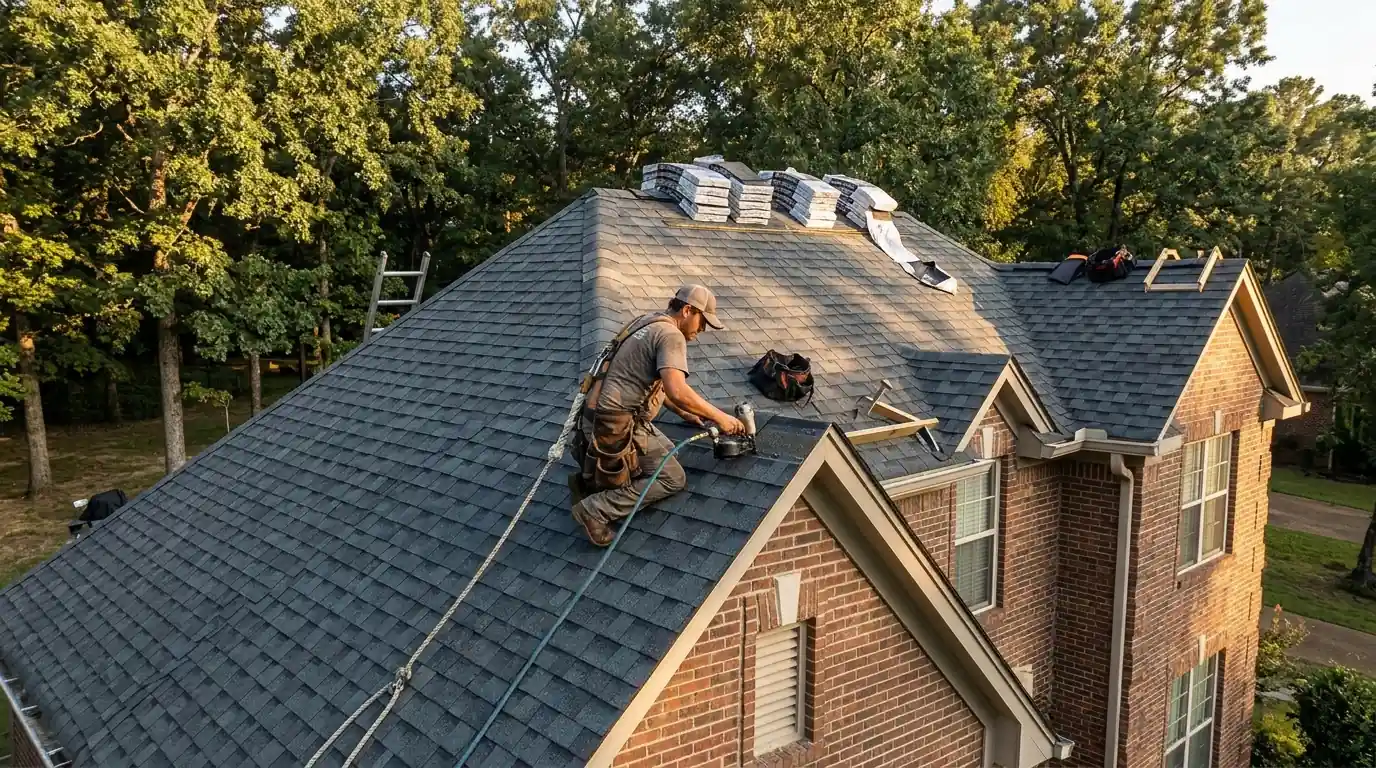
Little Rock is not one housing market, and its roofs show it. South of downtown, the Quapaw Quarter holds some of the oldest homes in Arkansas, including Trapnall Hall from 1843, along with Victorian houses on Scott, Center and Spring streets. Those roofs carry steep pitches, turrets, dormers and, on some houses, slate or old metal that needs a careful hand.
Move west along Kavanaugh Boulevard and you reach Hillcrest, once part of the town of Pulaski Heights, with most homes built between about 1890 and 1940. Capitol View and Stifft Station filled in mostly during the 1920s and 1930s with Craftsman bungalows. These neighborhoods share low eaves, exposed rafter tails, porch roofs tied into the main roof, and decking boards that have been nailed through three or four times.
After World War II the city spread out. Briarwood filled with 1950s and early 1960s subdivisions between West Markham and I-630, southwest Little Rock grew into blocks of brick and frame ranch homes around Geyer Springs, Cloverdale and Wakefield, and Pleasant Valley followed in the late 1960s and early 1970s. Chenal Valley began in 1990 and is still adding homes, which brings in steep architectural shingle roofs with many valleys, hips and skylights.
Spring is the rough stretch. From about March through June, thunderstorm lines roll across Pulaski County with hail, straight-line winds and the occasional tornado. The March 31, 2023 EF3 tornado crossed Chenal Parkway, tore through the Breckenridge area and crossed I-430 at Rodney Parham Road before heading toward Cantrell Road and the river. The city counted more than 2,600 damaged or destroyed structures.
Summer does slower damage. Long, humid stretches in the 90s bake asphalt shingles, dry out sealant strips and feed the dark algae streaks you see on north facing slopes all over town. Winter adds a few ice storms and freeze and thaw cycles that pry at flashing and loosen old caulk around pipe boots.
Then there are the trees. Little Rock is full of tall oaks and pines, from the ravines around Allsopp Park to the wooded lots in Chenal. Limbs come down in storms, needles pack valleys and gutters, and shade keeps moss growing on older roofs. Heavy rain bursts finish the job, overflowing clogged gutters and pushing water up under drip edge and into fascia boards that have already started to soften.
Each part of the city tends to call us for different reasons. Knowing the pattern helps us show up with the right materials on the truck instead of making a second trip, and it tells us where to look first once we are up on the roof.
Our office sits at 318 W 2nd Street, a few blocks from the River Market. That puts the Quapaw Quarter, the Governor's Mansion District and Capitol View within a short drive, and I-630 runs us west to midtown, Pleasant Valley, Rock Creek and Chenal in roughly 10 to 25 minutes. I-30 takes us south to Geyer Springs, Cloverdale, Wakefield and Otter Creek.
Our phones are answered 24/7 at (501) 387-1152. When water is coming in, we send a crew to tarp or patch first and talk about the bigger fix once the house is dry. After a hailstorm we photograph damage slope by slope, so you have clear pictures for your adjuster and for your own records.
The work itself is done by our own crews. You get a written price before anything starts, we show you what we find on the roof, and every job ends with cleanup and a magnet sweep of the yard and driveway for loose nails. Manufacturer warranty terms depend on the shingle or membrane you choose and on registering it, and we walk you through that before you decide.
Most Little Rock homeowners can reroof without any design review. National Register listing, which covers Hillcrest, Capitol View and much of the Quapaw Quarter, is an honor and does not by itself restrict what you put on your roof. The city's only locally protected district is MacArthur Park, where exterior changes go through the Historic District Commission.
Near the State Capitol and the Governor's Mansion, exterior alterations go before the state's Capitol Zoning District Commission. If your home sits inside those boundaries and you plan to change roofing material or appearance, we check what approval is needed before we order anything.
Newer neighborhoods bring a different kind of review. Many subdivisions in Chenal Valley, Rock Creek and Otter Creek have HOA architectural rules on shingle color or material. Bring us your HOA guidelines and we will match a product to them, then help you gather the specs your board usually asks to see.
Neighborhood pages
Most requested in Little Rock
Targeted fixes for worn shingles, failed flashing, cracked pipe boots and soft spots, priced in writing before our crew touches the roof.
How we handle itA complete tear-off to the deck with new underlayment, flashing, vents and shingles, finished in a day or two on most homes.
How we handle itFull roof assessment after a severe storm, covering debris impacts, mixed hail and wind damage, gutters and the attic below.
How we handle itSlope-by-slope hail inspection with marked test squares, soft-metal checks and photos that show exactly where the stones hit.
How we handle itWe follow the water back to where it actually gets in, fix that spot and stop the stain from coming back.
How we handle itLeaks, ponding water, split seams and failed drains fixed on low slope roofs for homes, porches, offices and small commercial buildings.
How we handle itOur downtown office keeps us close to most of the city. For an active leak in Little Rock we usually have a crew on site the same day or the next morning, depending on storm volume. If water is coming in at night, call anyway; we answer 24/7 and can talk you through protecting ceilings and belongings until the crew arrives with a tarp.
For a typical 1,600 square foot ranch home in Little Rock, a tear off and new architectural shingles usually runs $9,800 to $16,400. Larger two story homes in west Little Rock with steep pitches often land between $21,500 and $43,900. Decking repairs, extra layers to remove, ventilation changes and the shingle line you choose move the final number.
Usually not. National Register status in places like Hillcrest and Capitol View carries no roofing restrictions on its own. The exceptions are the MacArthur Park local district, reviewed by the Historic District Commission, and homes inside the state Capitol Zoning District near the Capitol and Governor's Mansion. We check your address before any material change so there are no surprises.
Hail can hit any part of Little Rock, but our spring calls tend to cluster in west Little Rock, where large roofs with many slopes and skylights take more hits, and in older midtown neighborhoods where worn shingles crack easily. After any storm we photograph each slope, mark bruised shingles and dented metal, and give you a written repair or replacement price.
Roof trouble in Little Rock?Call any hour. A person answers and books the first open crew.
Call (501) 387-1152